




Headless vs Standard Electric Guitar – The Lindo Afterlife
The headless guitar is the choice of touring professionals and studio players who demand precision without compromise. If you've always played a traditional electric, setting one up for the first time can feel unfamiliar. Here's everything you need to know.
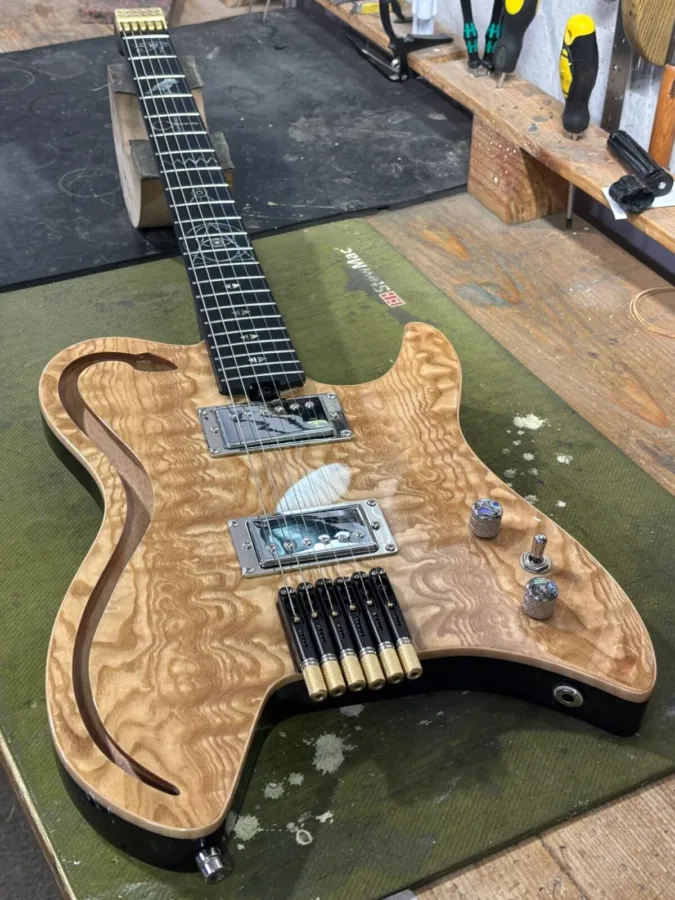
Why Headless?
On a standard electric guitar, the headstock houses the machine head tuners and provides the string break angle over the nut. Remove the headstock, as headless designs do, and you need an entirely different approach to both string retention and tuning.
On the Lindo Afterlife, the tuners are relocated to the bridge end of the guitar. Strings are locked at the nut end of the neck and tensioned from the bridge. This single design change creates several meaningful differences in how you set up and maintain the instrument.
Strings: Good News – Use What You Know!
Unlike some headless designs that require specialist strings, the Afterlife accepts completely standard single-ball-end electric guitar strings, the same sets you’ll find in any guitar shop. Whatever gauge you prefer, it’ll work.
Step-by-Step: Stringing the Lindo Afterlife
1. Remove the old strings. Detune fully using the knurled gold tuning cap on each bridge unit, release the string from the locking section above the nut, and pull free.
2. Feed the string through the bridge unit. Insert the ball end into the base of the corresponding bridge unit and thread the string up toward the nut
3. Seat the string at the locking nut section. Pass the string through the locking section above the ebony nut. Lock strings into place
4. Lock into place and bring up to tension. Turn the knurled gold cap on each bridge unit to bring the string up to pitch, working across all strings evenly.
Intonation & Saddle Adjustment
This works exactly the same as on a standard electric, adjust each saddle forward or backward until the 12th fret note matches the open string pitch. The fixed bridge design actually makes intonation more stable over time than a floating tremolo setup.
Pro tip: Always re-intonate when changing string gauge.
Action & Truss Rod: No Surprises Here
These are set identically to any electric guitar. Aim for approximately 1.4-1.6mm at the 12th fret on the high E, and 1.8-2mm on the low E, adjusting to taste.
Tuning Stability: Where Headless Excels
With strings locked at the nut and retained firmly in the bridge units, and no excess string wound around tuning pegs, the Afterlife holds pitch exceptionally well. After a fresh restring, pull each string gently away from the fretboard a few times and retune to help them settle quickly.
Travelling With a Headless Guitar
Without a headstock, the Afterlife is shorter by several inches – compact enough for overhead luggage on most airlines and far easier to carry on public transport.
Summary
The main difference from a standard electric is simply how the strings are loaded and tuned. Once that’s second nature (and it will be after your first restring!) everything else is exactly what you already know. The result is a guitar that balances perfectly, holds tune under pressure, and turns heads every time you take it out of the case.