




The Care Behind Every Lindo Electric Guitar Setup
Before every Lindo electric guitar leaves us, it goes through a careful hand setup — from neck relief, nut height and saddle adjustment to fret polishing, intonation, pickup height and final playability checks.
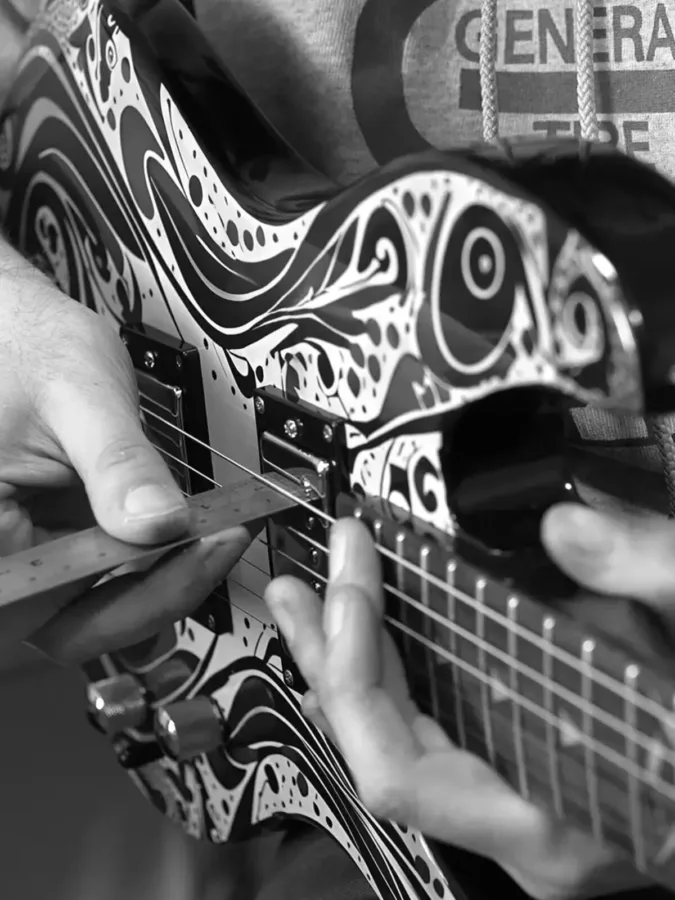
Relief
Setup starts at the neck.
We check the relief — the slight forward curve that allows the strings to vibrate cleanly — and adjust the truss rod where needed so it sits correctly for that individual guitar.
It is a precise part of the setup. Even a small change here can affect the action, feel, and overall playability, so we take our time getting this right before moving on to the next stage.
Nut
From there, we check the nut and the way each string sits in its slot.
This area has a big effect on how the guitar feels in the lower frets. If the string sits too high at the nut end, the first few frets can feel stiff or uncomfortable to play. If it sits too low, unwanted buzzing can occur.
Each slot is checked carefully and adjusted where required, so the strings sit at a comfortable and reliable height.
Saddle Height
On an electric guitar, saddle height is adjusted string by string at the bridge.
We set each saddle to follow the radius of the fretboard, helping the action feel balanced across all six strings. This means the guitar feels consistent whether you are playing rhythm parts on the lower strings or lead lines higher up the neck.
It takes more time than a fixed bridge setup, but it allows much greater precision.
Fret Polish
Every fret is checked and polished before the guitar is completed.
Fresh from production, frets can sometimes have small surface marks or fine residue that may not be obvious to the eye, but can still be felt when playing.
Polishing helps bring the frets to a smoother finish, making the neck feel cleaner, faster, and more comfortable for bending, vibrato, and general playing.
Fretboard Treatment
Depending on the model, the fretboard may be composite, laurel, maple, or another selected material.
At this stage, the fretboard is cleaned and treated as appropriate for that material. We make sure the surface is in good condition before the final stringing and setup checks are carried out.
The aim is simple: a clean, smooth, comfortable playing surface that feels right under the fingers.
Body Polish
The body is also checked and polished before dispatch.
Any light marks from handling, production, or packing are cleaned and polished where possible, so the guitar leaves us looking its best.
This is part of the final care that goes into the instrument before it is packed for its journey.
Stringing Up and Action Check
Once the guitar has been cleaned and prepared, it is strung, tuned to pitch, and checked under proper string tension.
This is important because string tension changes how the neck, action, and bridge behave. We measure and check the action again, then go back over the relief, nut, and saddle height where needed.
This second check confirms that the setup works under real playing conditions, not just while the guitar is on the bench.
Intonation
With the guitar tuned and the action confirmed, we set the intonation.
This means adjusting the position of each saddle so the guitar plays as accurately as possible across the full length of the neck, not only in open position.
We check each string carefully, comparing the 12th fret harmonic with the fretted 12th fret note, and adjust the saddle until they match as closely as possible.
Good intonation makes a real difference once you move beyond open chords and start playing higher up the neck.
Pickup Heights
The final stage is pickup height.
The distance between the pickups and the strings has a noticeable effect on tone and output. If the pickups are too far away, the signal can feel weak. If they are too close, they can affect sustain, clarity, and balance.
We adjust the pickups to give a strong, even output across the strings, with a good balance between the bass and treble sides.
The Result
By the time a Lindo electric guitar is packed and ready to leave us, it has been through each stage of this setup process by hand.
Full scale or short scale, every model receives the same careful attention.
After transit, the guitar may need a quick tune-up, but the aim is for it to arrive comfortable, checked, and ready to enjoy from the first playing session.