




Lindo After Life Fingerboard: The Eye of Horus at Its Heart
Inspired by ancient Egyptian symbolism, the After Life fingerboard tells a story of protection, life, transition, and the journey beyond.
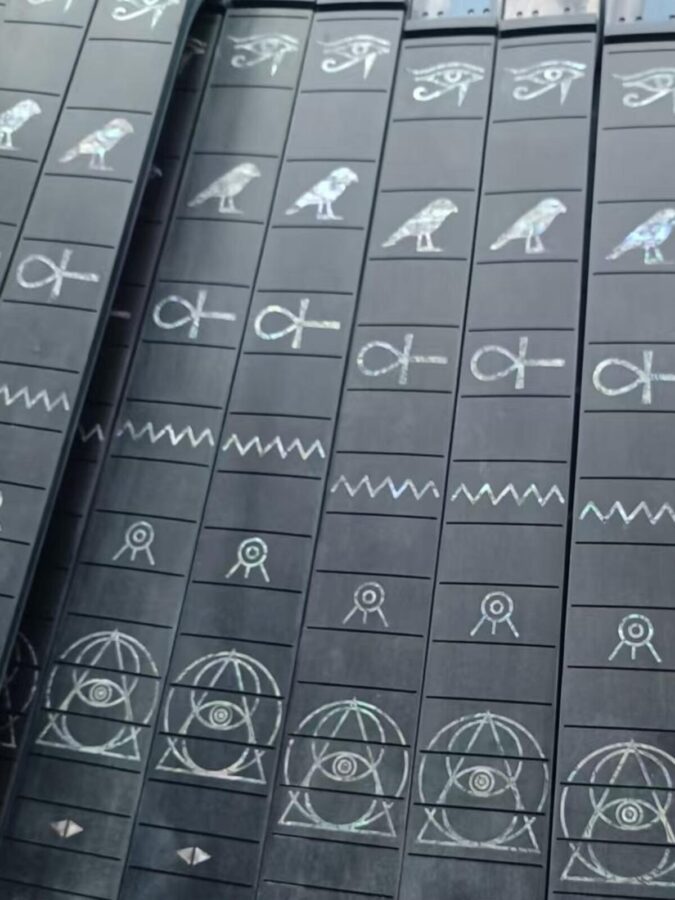
The Lindo After Life fingerboard was designed to feel like more than a set of position markers.
It is a story told through symbols.
At the centre of the design is the Eye of Horus, placed at the 12th fret — one of the most important points on the fingerboard.
In ancient Egyptian symbolism, the Eye of Horus is often associated with protection, healing, awareness, and restoration. It is a symbol that watches, guards, and guides.
For a guitar called After Life, this felt like the right symbol to place at the heart of the neck.
Around it, the other inlays continue the journey.
The bird can be read as the soul in motion — a quiet sign of freedom, transition, and movement beyond the physical world. The ankh is one of the most recognisable ancient Egyptian symbols of life and eternity, connecting naturally with the idea of the afterlife. The flowing and geometric lines add a feeling of energy, vibration, and passage, almost like sound travelling through the instrument.
Together, these symbols create a fingerboard with a darker, more mysterious character.
It is not decoration for decoration’s sake.
It is a visual language shaped around life, protection, memory, and the unknown journey beyond.
For us, the After Life inlay is part of the guitar’s identity — something the player sees, feels, and follows every time their hand moves along the neck.