




Lindo · White Dove
White Dove
A familiar instrument.
A different point of view.
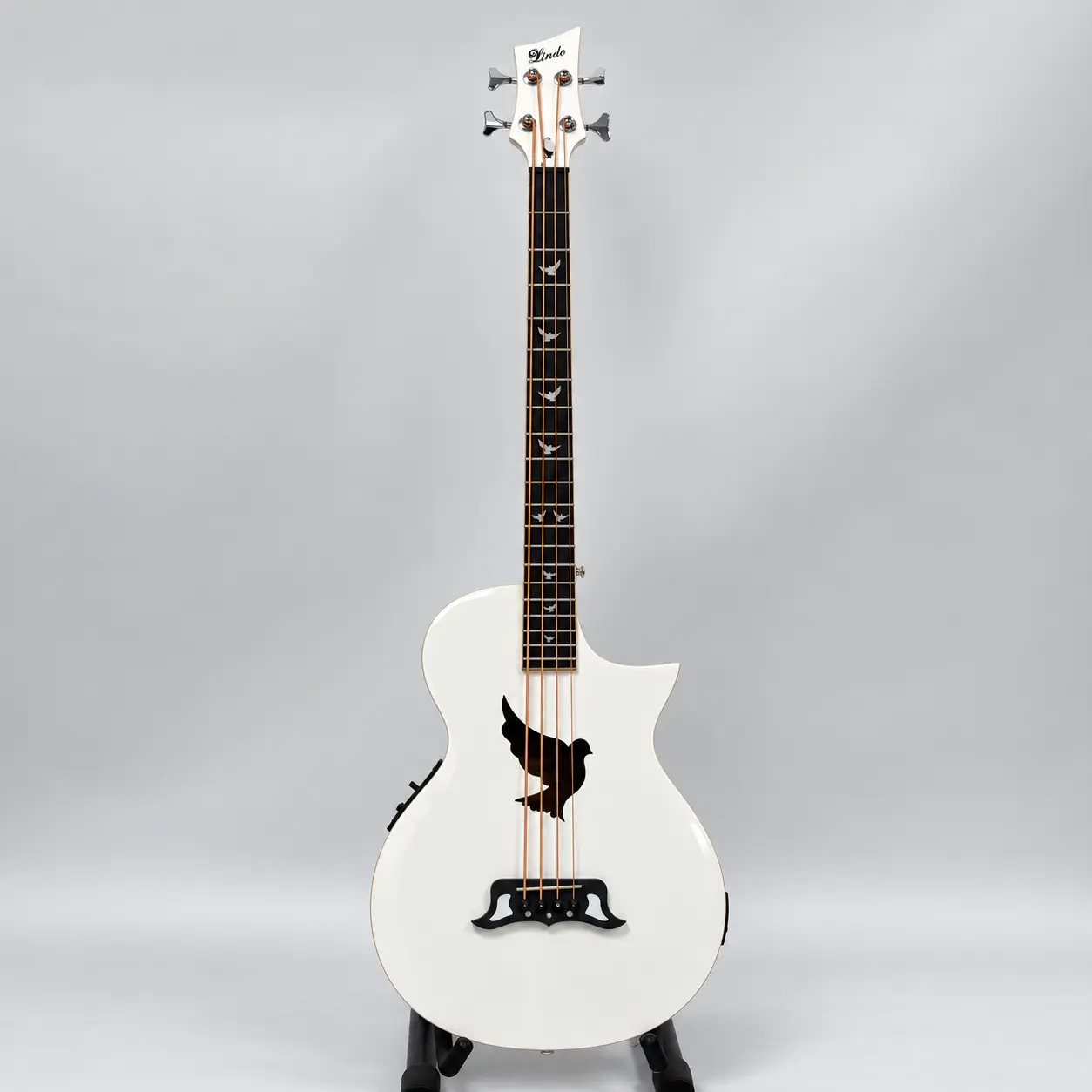
A short scale electro acoustic bass with a shape and a character of its own.
The White Dove takes the rounded outline of an acoustic bass and gives it a more individual expression. The sweeping cutaway, open dove-shaped soundhole and sculpted headstock draw the eye; gloss white, dark composite wood and warm maple edges bring the details together.
Behind that distinctive appearance is a four-string instrument with a 30-inch scale and onboard EQ and tuning. A premium hard case completes the instrument and case pairing.
01 · Form and finish
A dove at the centre of the design
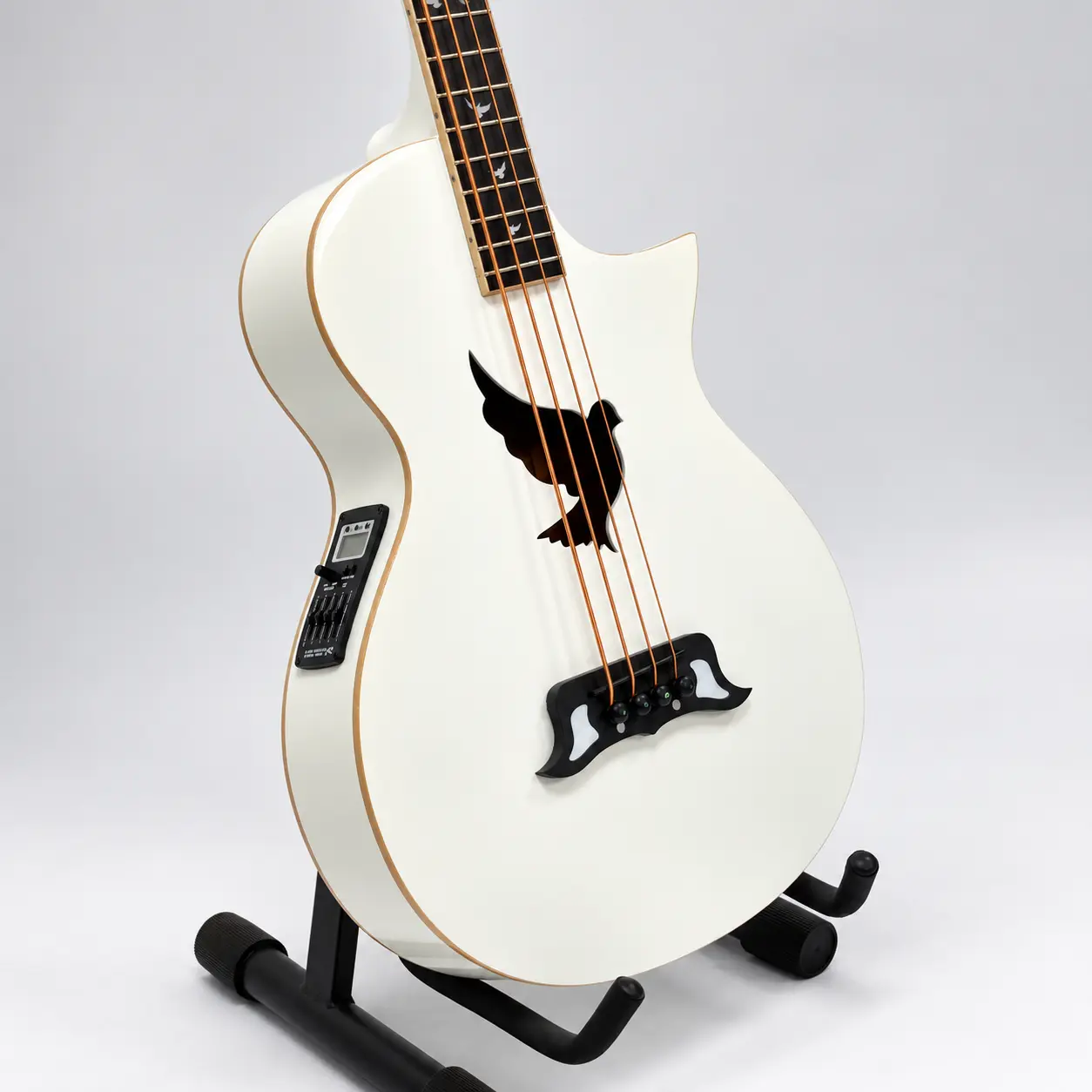
The bird is more than a motif on the surface. Its outline forms the soundhole itself, opening through the white spruce top to the interior of the bass. The same idea returns in the mother-of-pearl fretboard inlays and the recessed detail of the aluminium truss rod cover.
Roasted-maple binding traces the body and fretboard, bringing a natural contrast to the gloss-white finish. The single cutaway follows a clean, asymmetric line beside the upper frets.

02 · The playing format
Short scale, considered in detail
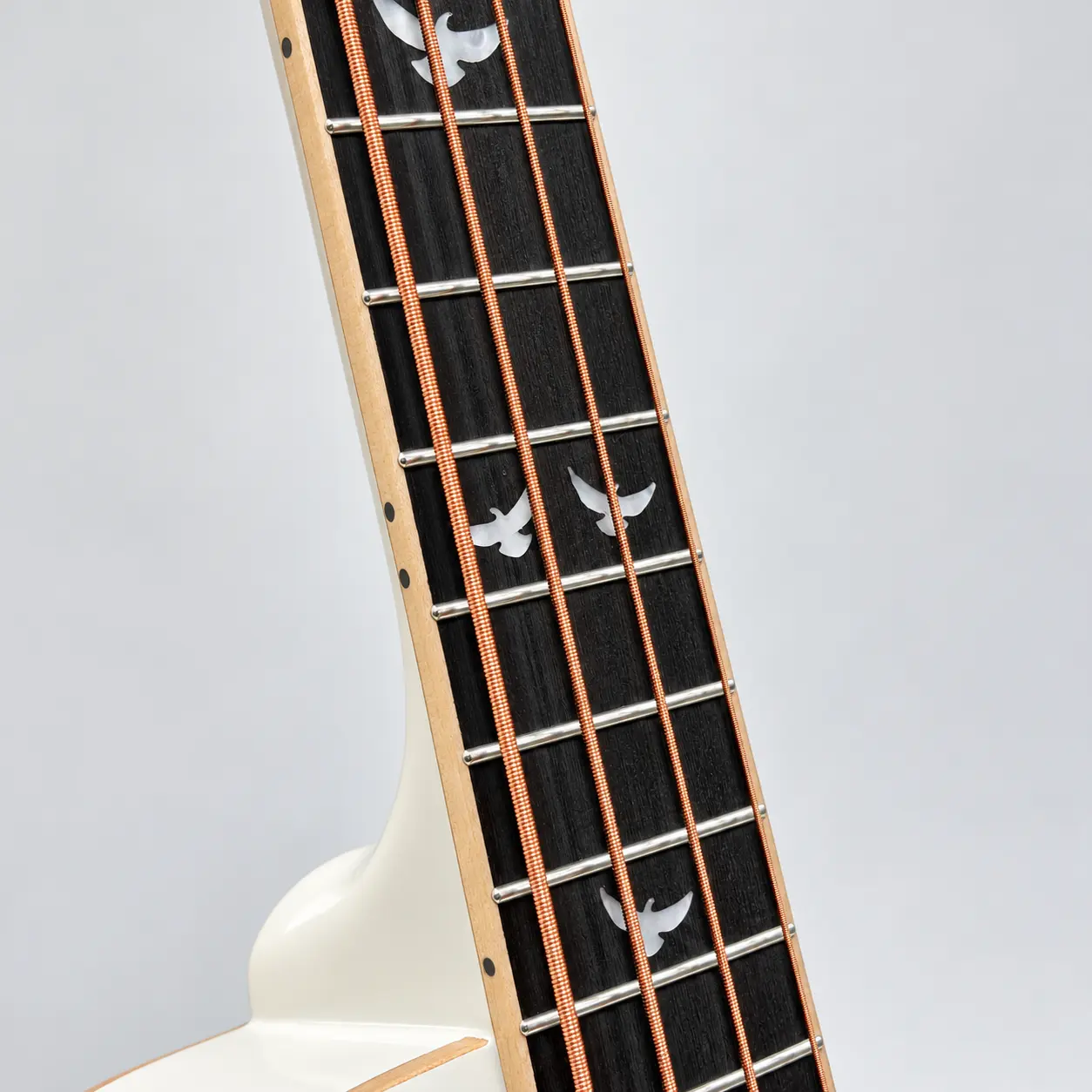
A 30-inch scale gives the White Dove its short scale format, paired with a 43 mm nut and 20 frets. The mahogany neck has a C-shaped profile, while the black composite-wood fretboard has a 16-inch radius and roasted-maple binding.
The details continue along its edge: 3 mm nickel-alloy fretwire has rounded ends, and luminous side position markers complement the dove inlays. Inside the neck, two carbon fibre reinforcement rods sit alongside a dual-action truss rod.
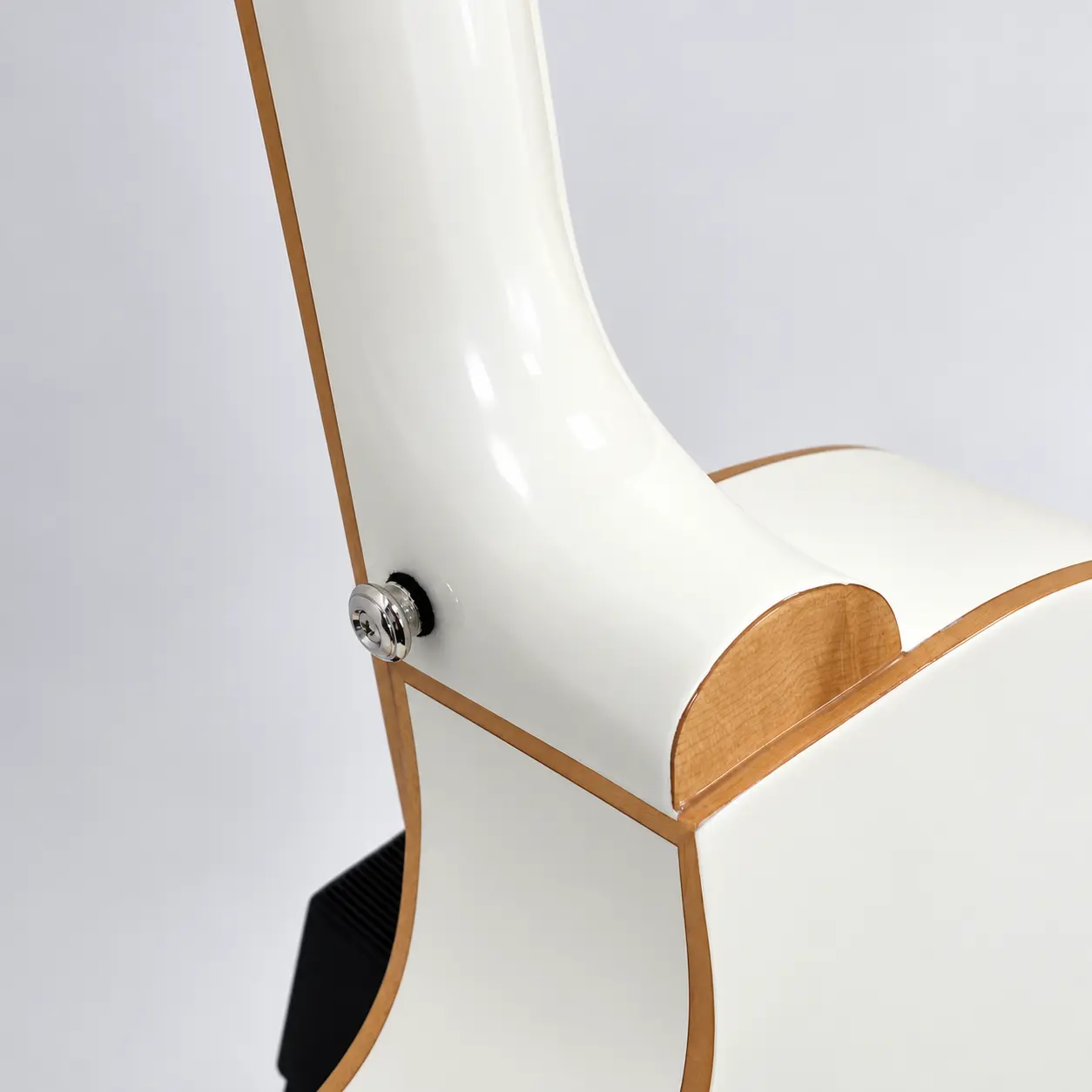
At the body, a dovetail neck joint and chrome heel strap button sit beside the natural maple edging. The body measures 80 mm deep.
03 · Beneath the surface
Construction with a purpose
Beneath the white finish, the White Dove uses openwork body bracing and a reinforced mahogany neck. The bracing is designed to give its soundboard the support it needs while keeping the framework light. Its openings are part of the structure’s approach to weight and vibration, rather than a decorative detail.
Less brace mass, considered support
An acoustic bass soundboard carries the pull of the strings through the bridge, but it also needs to move to produce sound. The braces help manage that balance by supporting the top and shaping the way it vibrates.
Removing selected areas of wood reduces brace mass compared with an otherwise identical unperforated brace. That means less material is attached to the vibrating top. The aim is to avoid unnecessary weight while retaining a supporting framework, helping the soundboard respond to energy coming from the strings.
Brace shape, placement and mass work together with the top to determine its response. The range illustration below introduces the openwork principle; the White Dove bass workshop photograph in the next chapter shows its own arrangement of crossed braces and circular openings.

Twin carbon fibre neck reinforcement
Built to last
Lindo instruments find homes around the world, from Alaska to Singapore. For the White Dove, that makes neck stability an important part of the design. Temperature and humidity can change between climates, seasons and even the rooms where an instrument is played and stored. Wood responds to its surroundings, and a small change in neck curvature can affect string clearance and the feel of the action.
Two carbon fibre reinforcement rods run within the White Dove’s mahogany neck, alongside its dual-action truss rod. Carbon fibre adds stiffness with little extra weight, helping the neck resist unwanted bending and twisting. This paired reinforcement gives the neck additional structural support, with the aim of maintaining a consistent playing feel as temperature and humidity change.
The carbon fibre rods provide reinforcement; the truss rod remains the adjustable part of the system. It allows neck relief, the slight curve that gives vibrating strings clearance above the frets, to be adjusted in either direction when a setup is needed. Together, they bring stability and adjustability to a part of the instrument that matters every time you play.
Long-term stability also benefits from thoughtful care: use the included hard case when storing the bass, avoid extremes of temperature and humidity, and allow it to acclimatise after travel. The Lindo-range assembly image below shows the central truss-rod area and side channels before the fretboard is fitted.
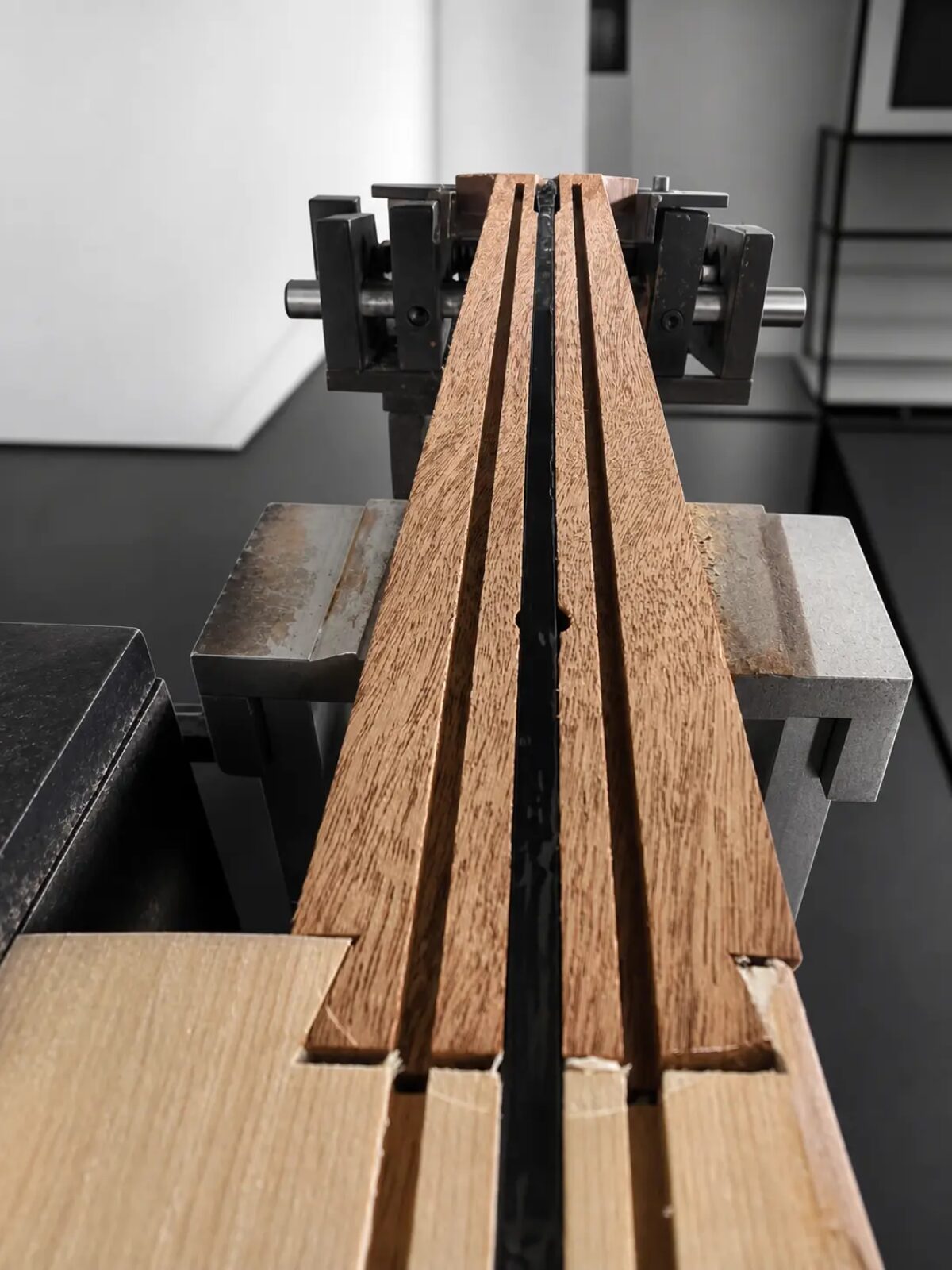
Workshop photographs · White Dove
The White Dove, in the making
The finished White Dove brings together a bright white body, a dark dove-shaped opening and a warm line of maple edging. These workshop photographs offer a different view of those familiar details, before the final finish is in place. From the cut-out in the soundboard to the work around the cutaway, they reveal parts of the instrument that are easy to overlook once the bass is complete. There is something particularly engaging about seeing the design take shape in its unfinished form.
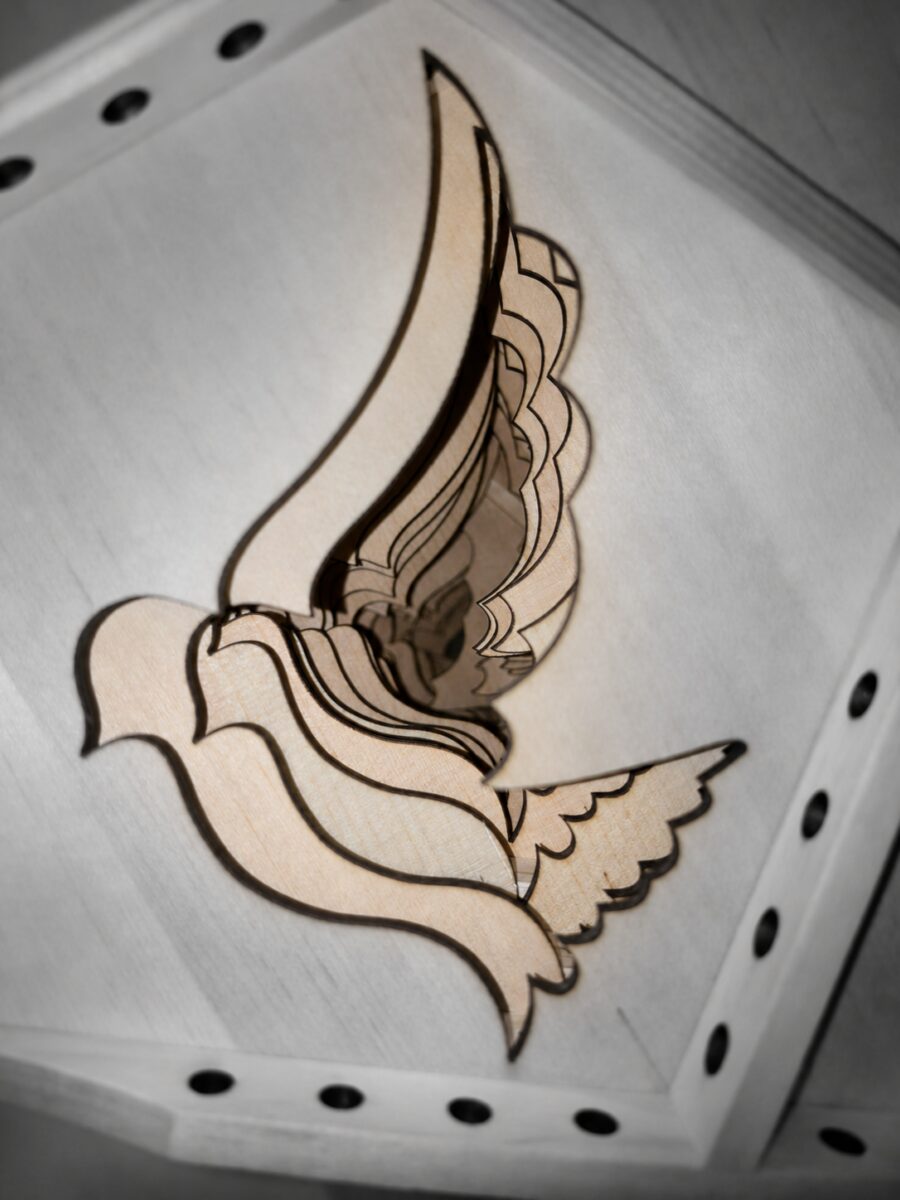
An opening with a character of its own
Before the white finish is applied, the dove is already recognisable. The broad wing, small head and pointed tail are defined by the opening itself, with the exposed cut edges giving the outline a clear sense of depth. This close view shows how much of the White Dove’s identity belongs to the shape of the soundboard, rather than to a decoration added to its surface.
On the completed bass, the pale top and the darker interior make that same silhouette stand out. Here, the unfinished surface brings the attention back to its contours: an individual detail that remains at the centre of the instrument’s design.
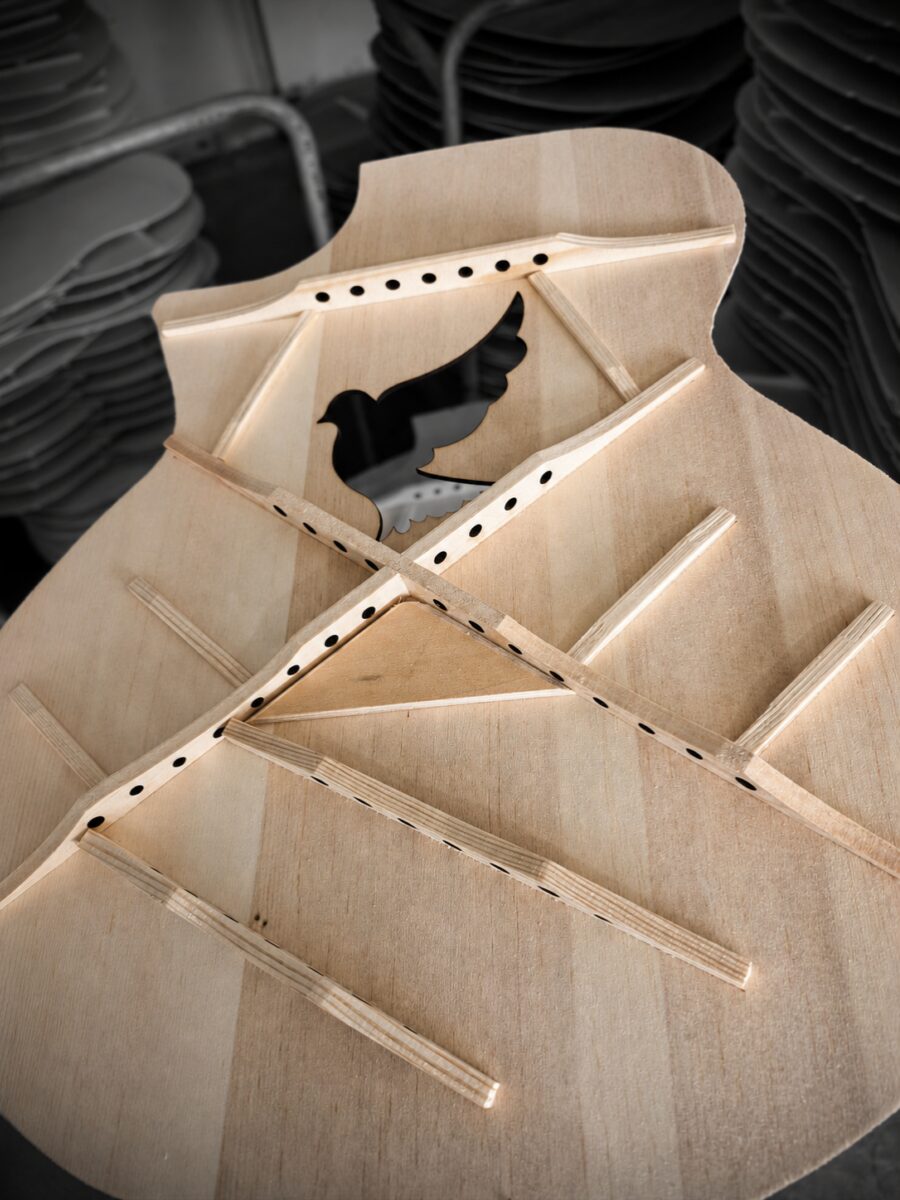
Openwork X-bracing: support with less mass
The workshop view makes the construction easy to follow. Two long braces cross beneath the soundboard, with circular openings cut through their sides. The upper cross-brace also has a row of openings, while smaller braces complete the layout around the dove-shaped soundhole. Continuous wood remains around the openings and along the braces’ upper and lower edges.
The circular openings remove material from within the brace profile while leaving its overall height in place. A brace’s depth is important to how it resists bending, so retaining that height is part of the design approach. The edges and wood between the holes remain part of the supporting structure.
For an acoustic bass, this is a purposeful balance: support for the string-loaded top, with less brace material for that top to move. It is intended to encourage a responsive soundboard while keeping a defined framework beneath it. The photograph shows how this idea is built into the White Dove, long before the body receives its gloss-white finish.
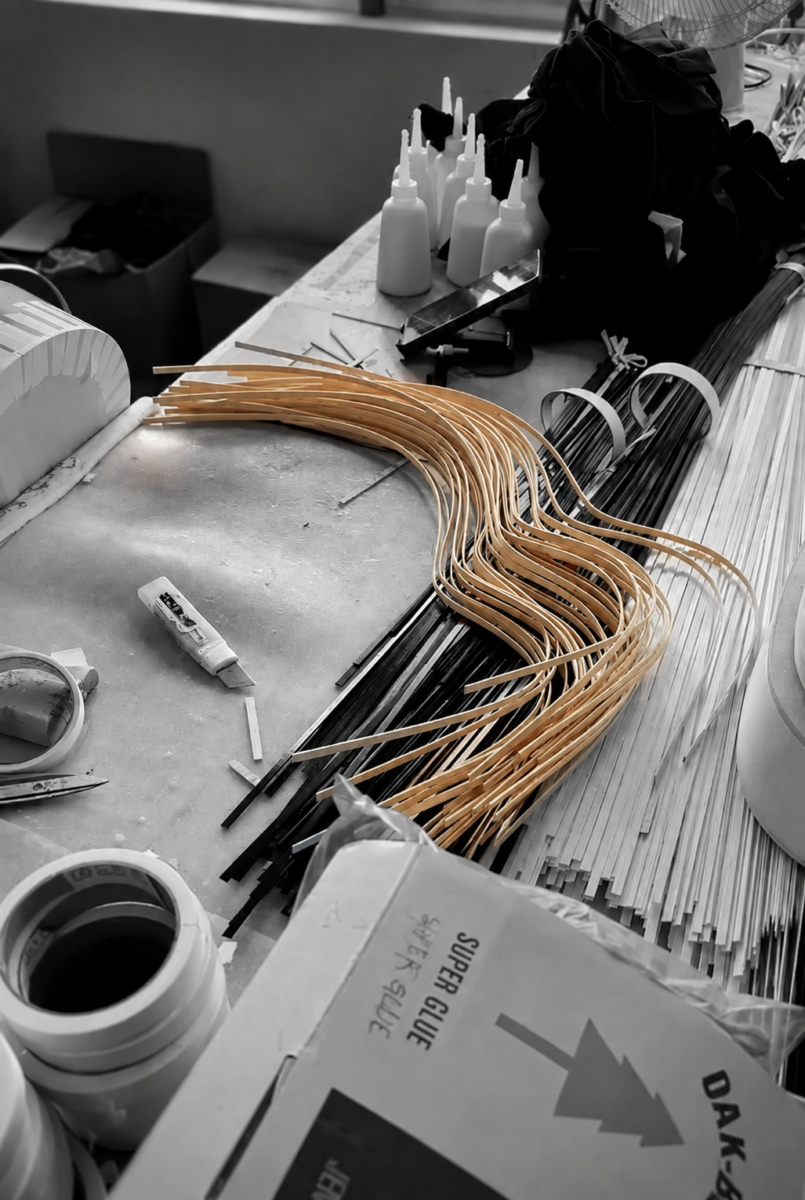
Preparing the body edging
A collection of curved edging strips rests on the workbench beside straight lengths of light and dark trim. Away from the instrument, these slender pieces make the changes in the body outline easier to appreciate: the sweep around the lower bout, the inward curve of the waist and the turn towards the shoulder.
On the finished White Dove, roasted-maple binding follows the body’s perimeter, adding a warm border to the white finish. The workshop view draws attention to edging as a separate part of the build, before it becomes the continuous line seen around the completed bass. It is a small detail in width, yet a visible part of the overall appearance.
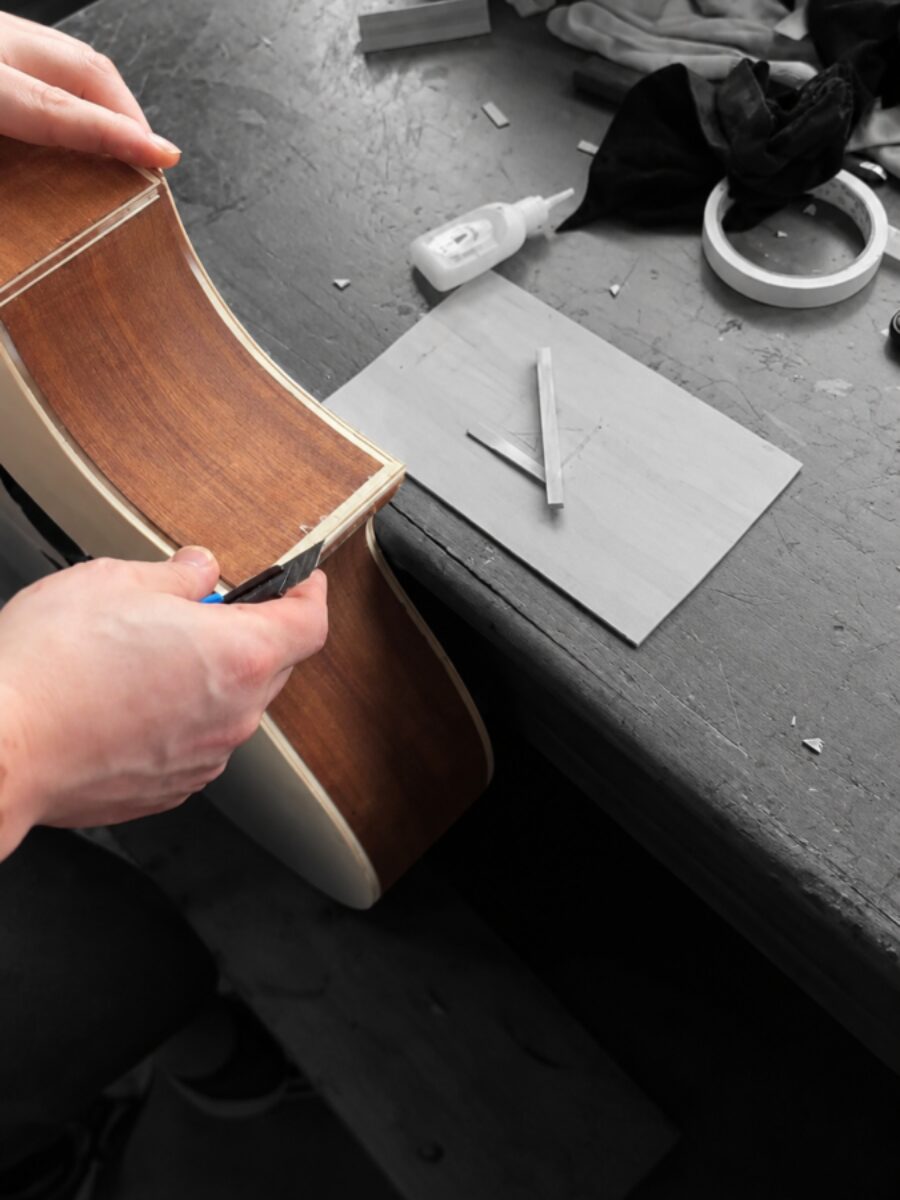
Following the cutaway by hand
The body is held close as a small hand tool works along the edge near the cutaway. At this stage, the unfinished side, pale body face and narrow edging can all be seen together. The photograph brings the focus to their meeting point, following the curve where the outline turns in towards the neck.
That area is especially distinctive on the White Dove: a flowing cutaway set against the rounded body. Seen close up during production, it becomes a sequence of surfaces and edges being worked on. Seen on the finished bass, those separate details come together as the clean border around the white body.
04 · Strings and bridge
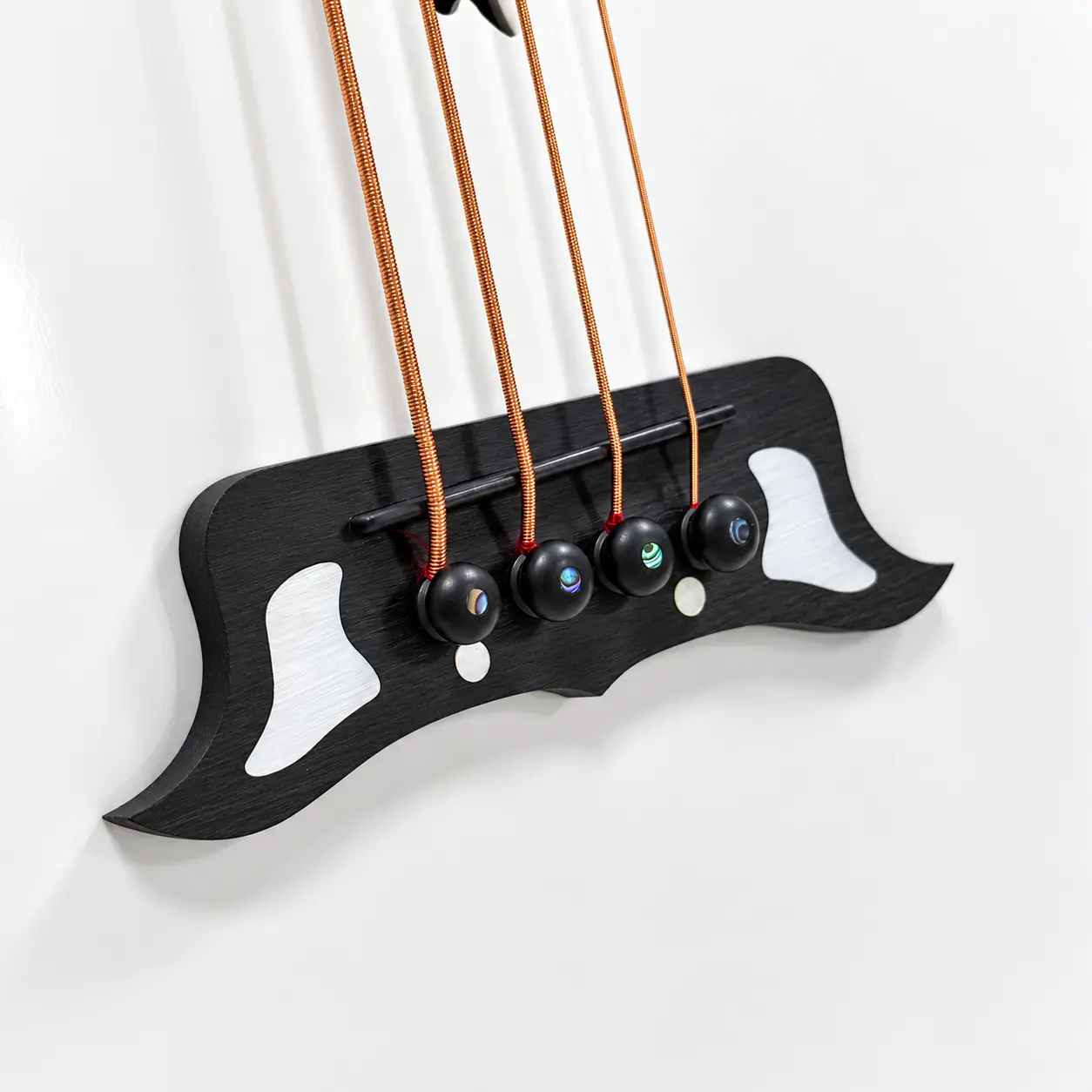
The bridge, saddle and strings
The White Dove is fitted with four bass strings in .045–.105 gauges, arranged across its 30-inch scale.
Four black bridge pins with coloured shell centres sit across the black composite-wood bridge. Its open, wing-like form echoes the soundhole above, with a 75 mm graphite saddle completing the assembly.
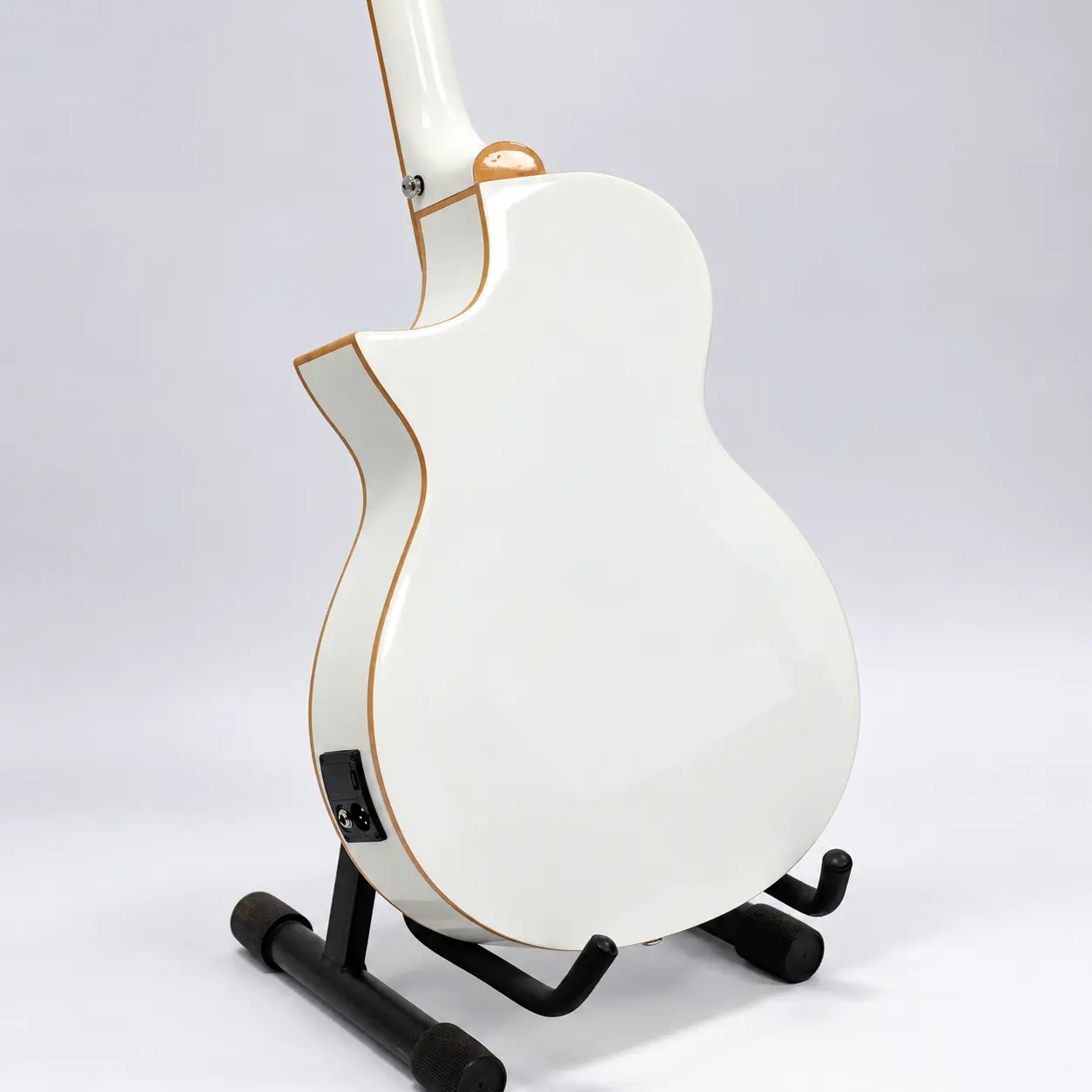
Spruce is used for the top, with sapele for the back and sides. The interior uses openwork bracing, while the same gloss-white finish carries around the back of the instrument.
05 · From nut to headstock
The same character, all the way up
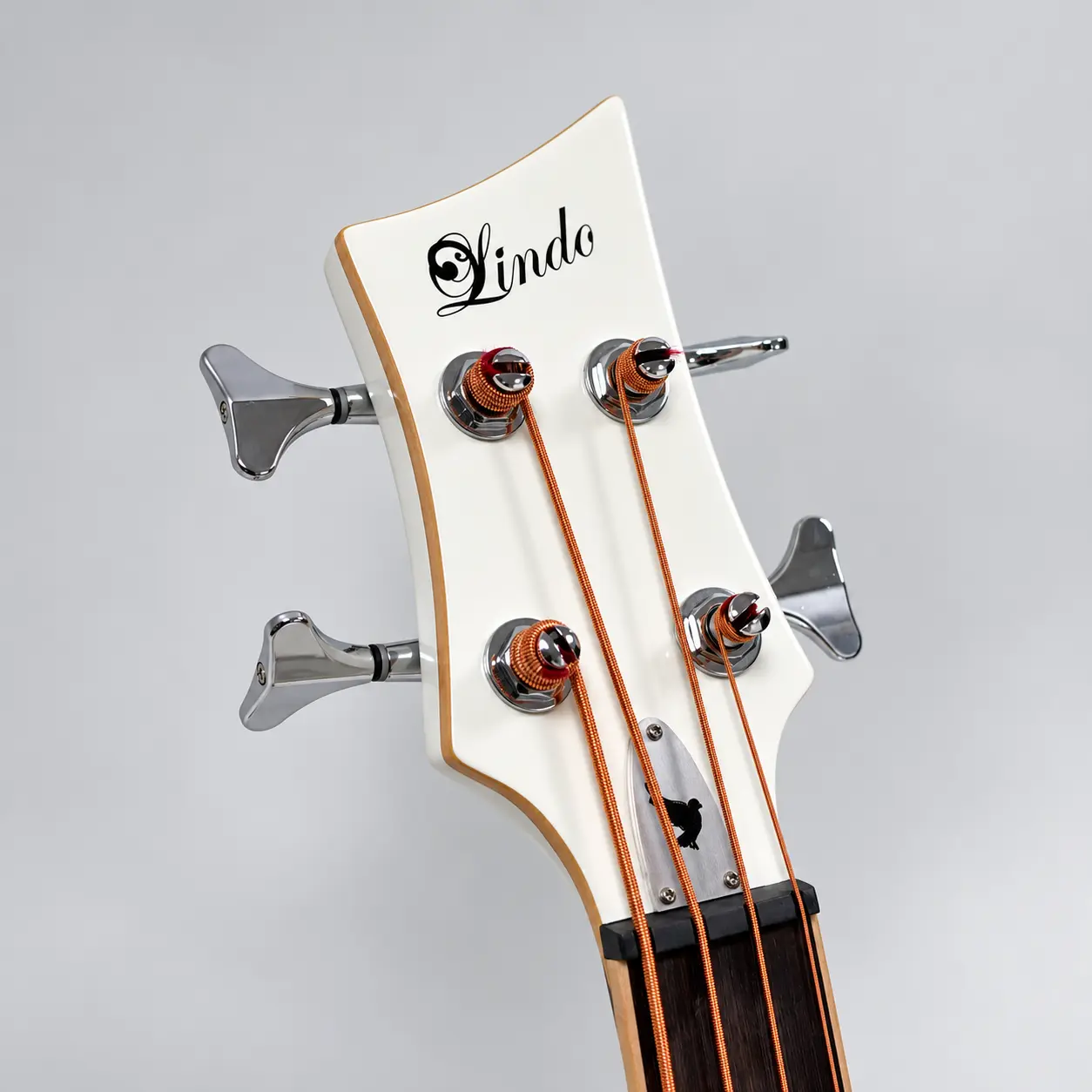
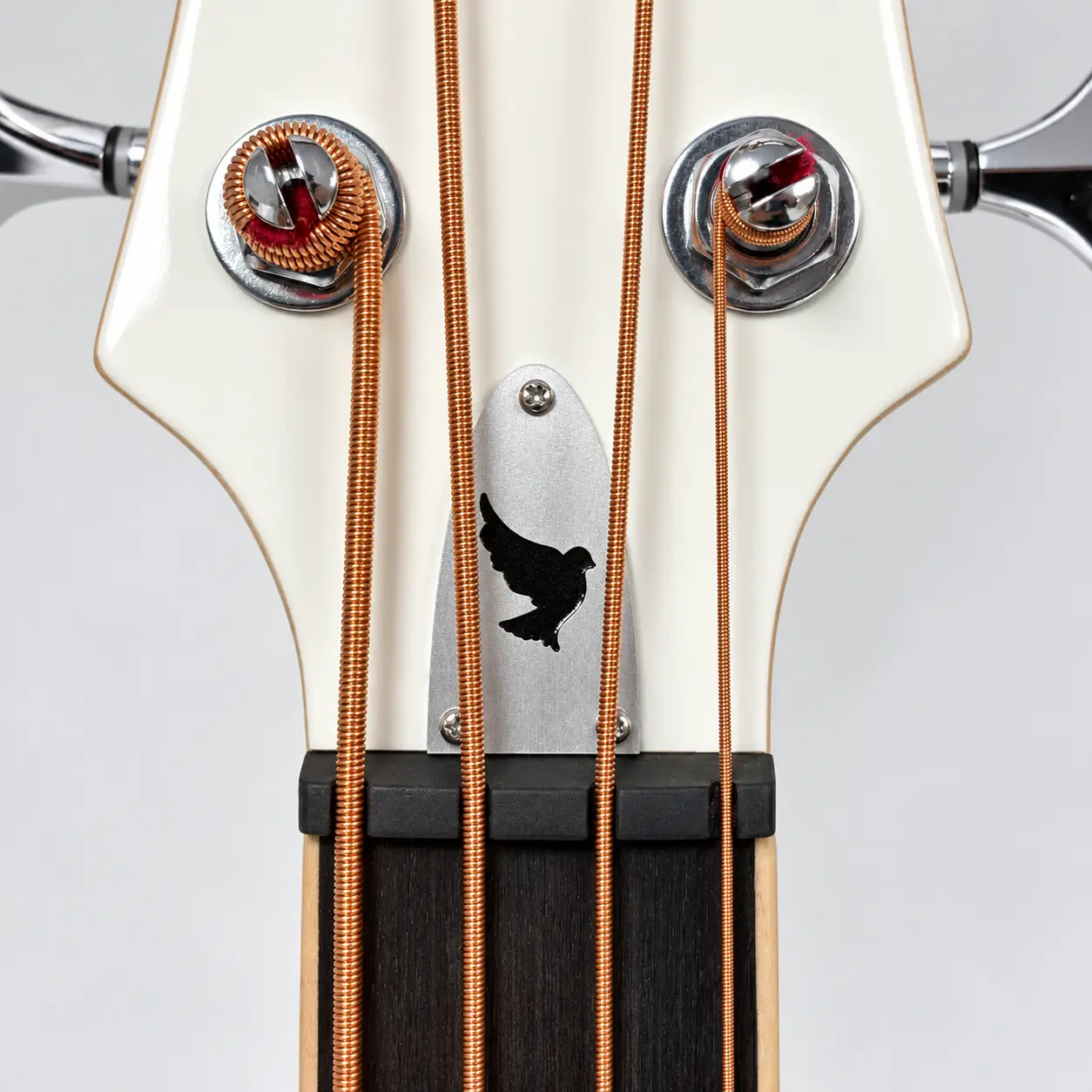
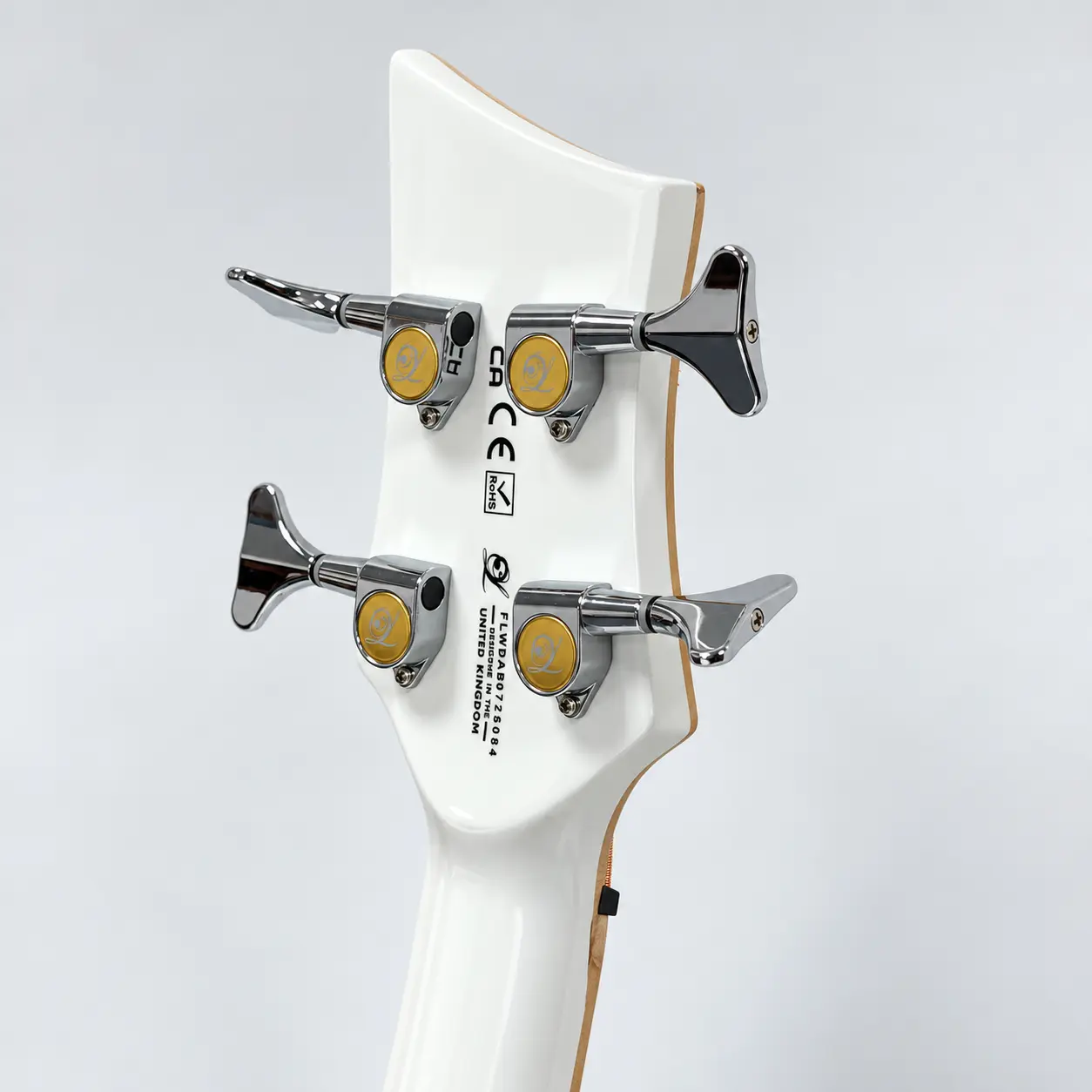
The headstock continues the body’s flowing outline, white finish and natural-coloured edge. Four chrome tuning machines use an 18:1 ratio; their gold-coloured Lindo rear covers add a small, warm detail against the white.
A 43 mm high-density synthetic nut sits below the aluminium truss rod cover. The recessed dove in the cover brings the design back to the bird at the centre of the body, while a volute is formed into the rear of the headstock.
06 · Onboard electronics
Your controls, close at hand
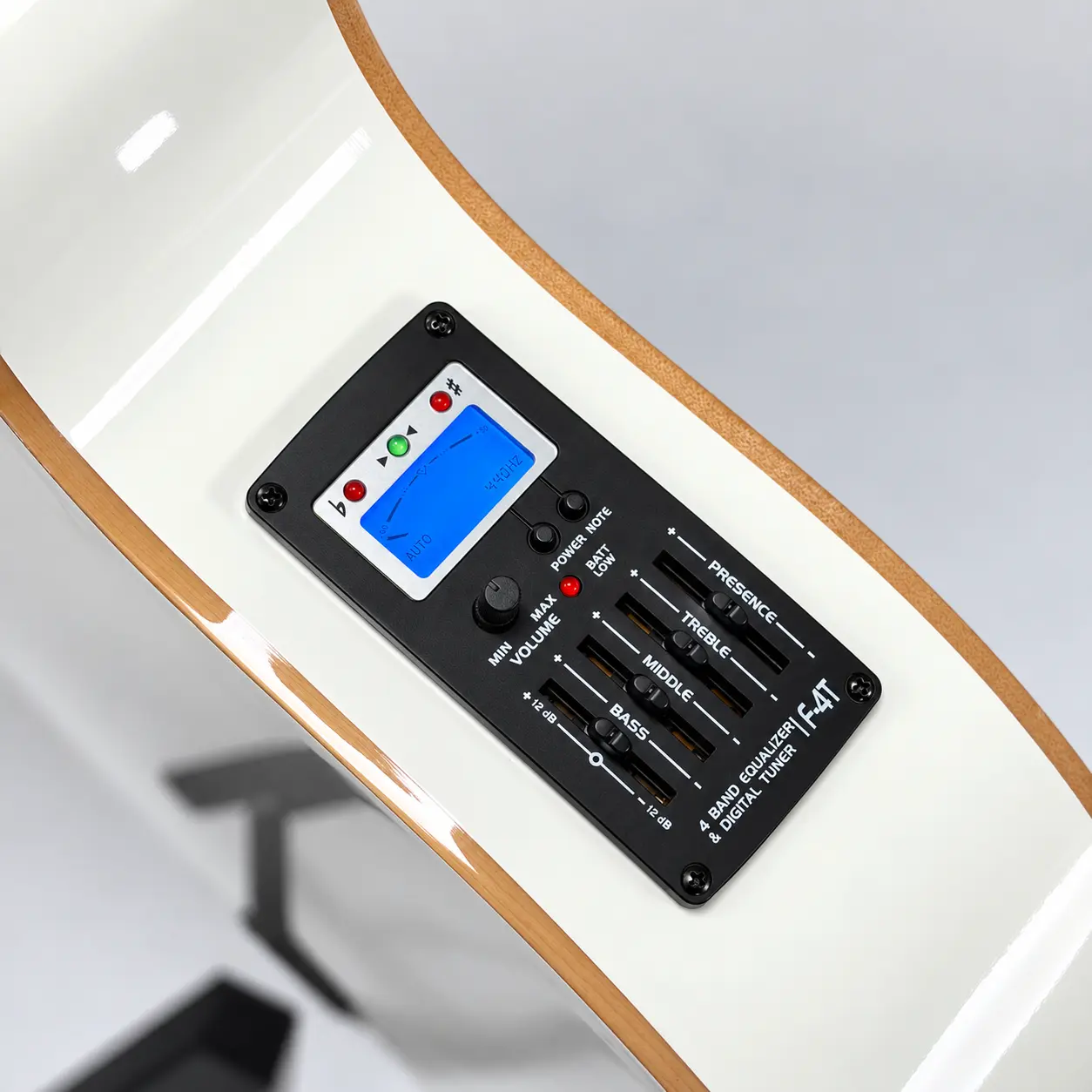
The side-mounted F-4T panel brings together four bands of EQ, master volume and a digital tuner. Separate bass, middle, treble and presence sliders let you adjust the amplified sound from the instrument.
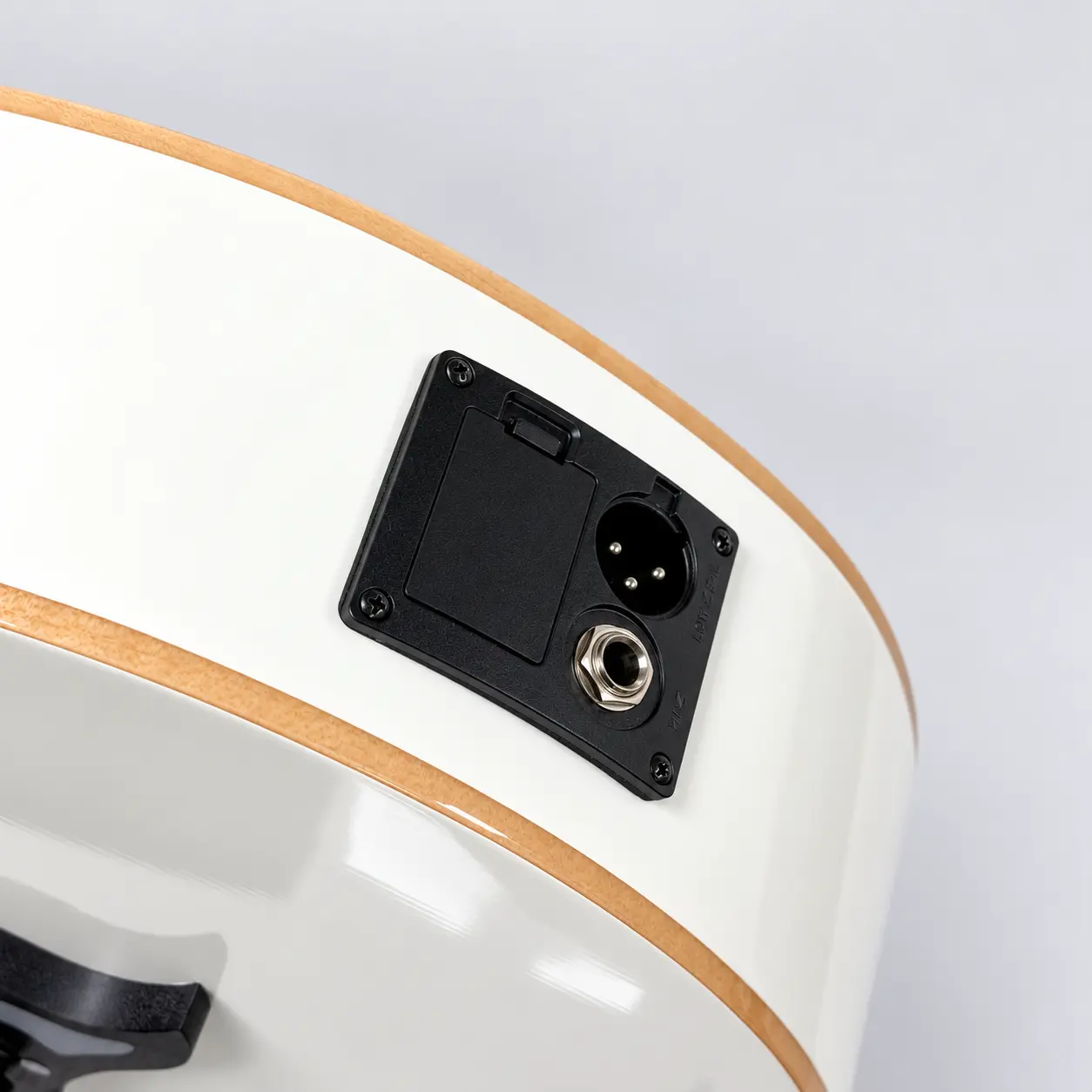
The tuner display is built into the same panel, keeping tuning and sound adjustments in one place. Jack and XLR output sockets are housed together at the base of the body, alongside the chrome base strap button.
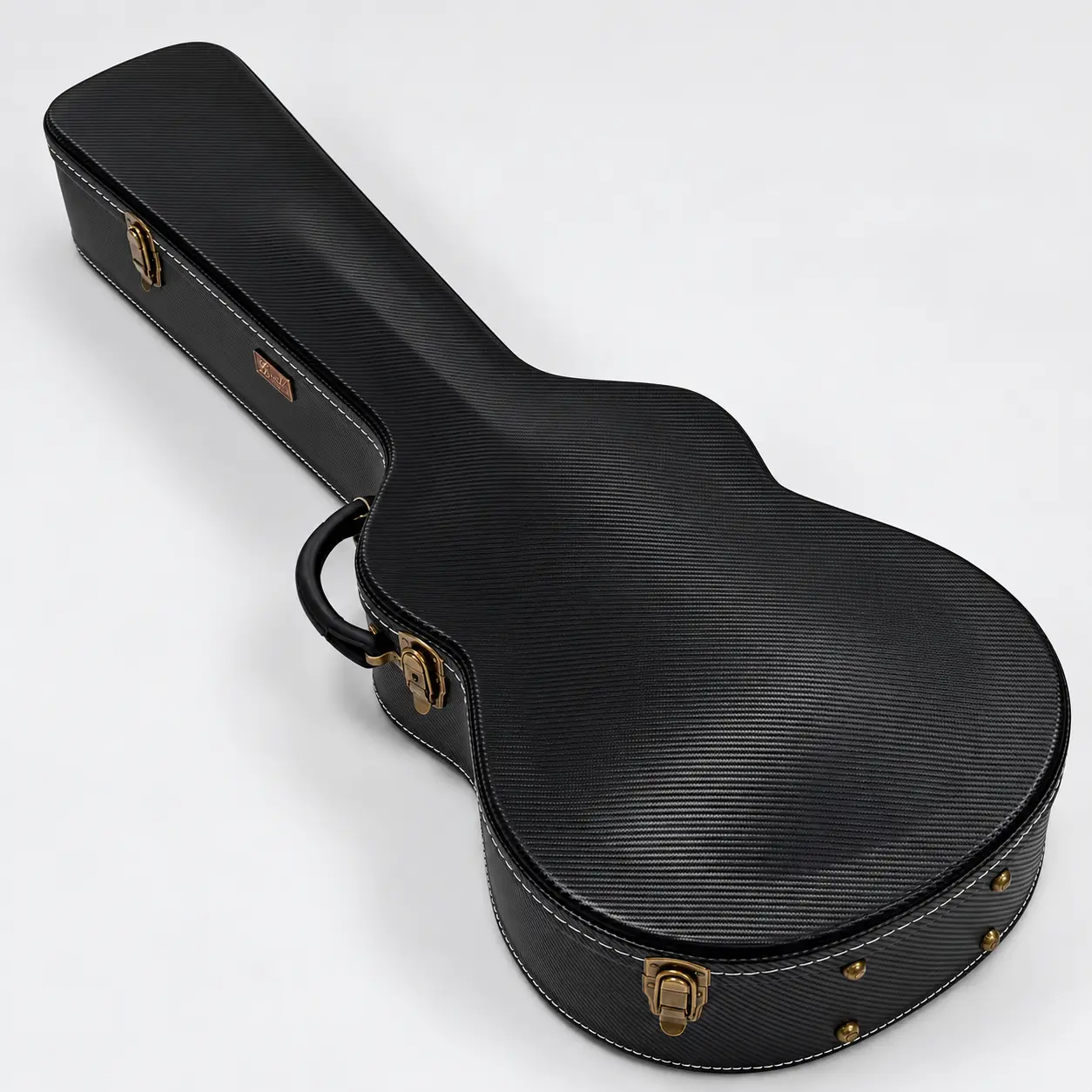
07 · A case of its own
Premium hard case included
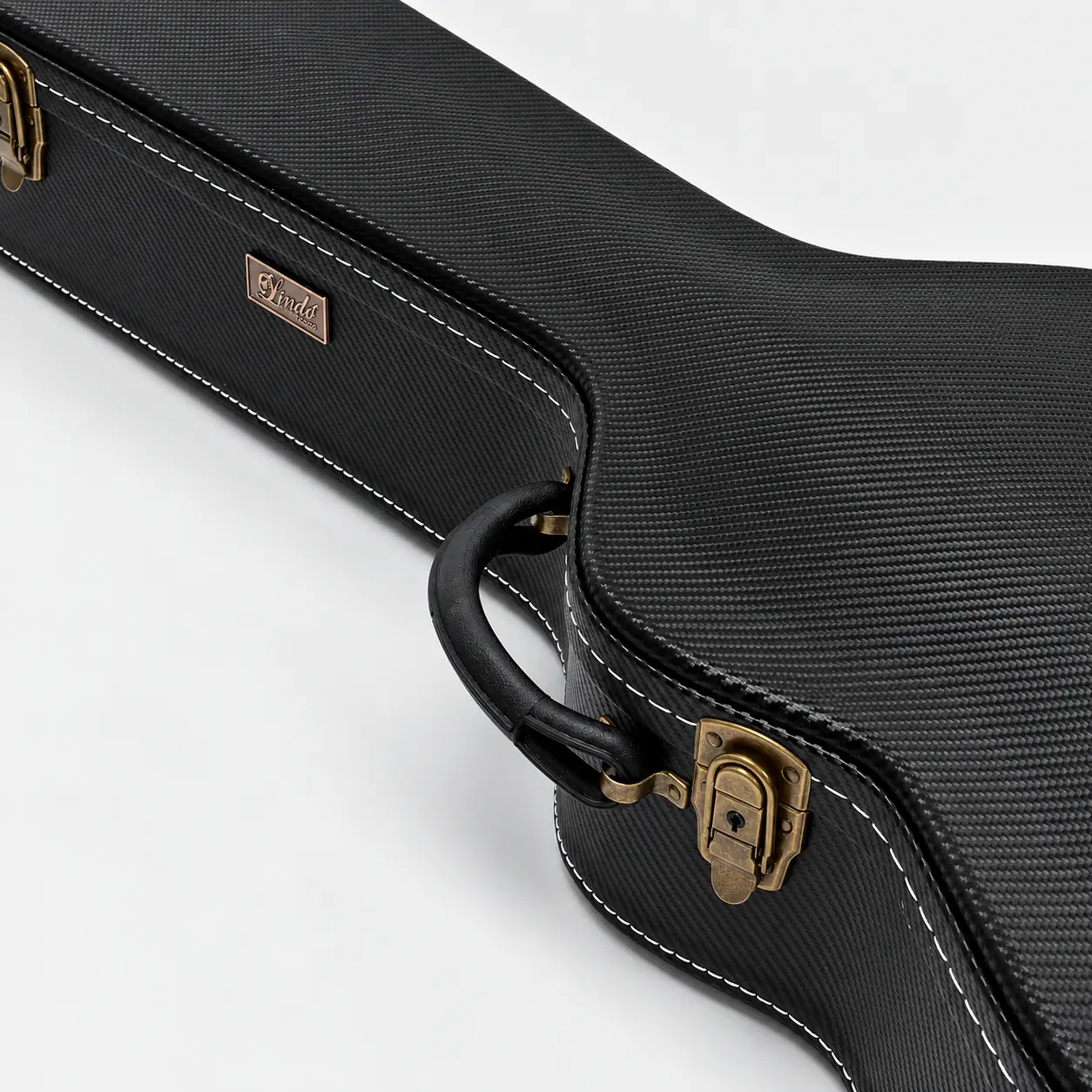
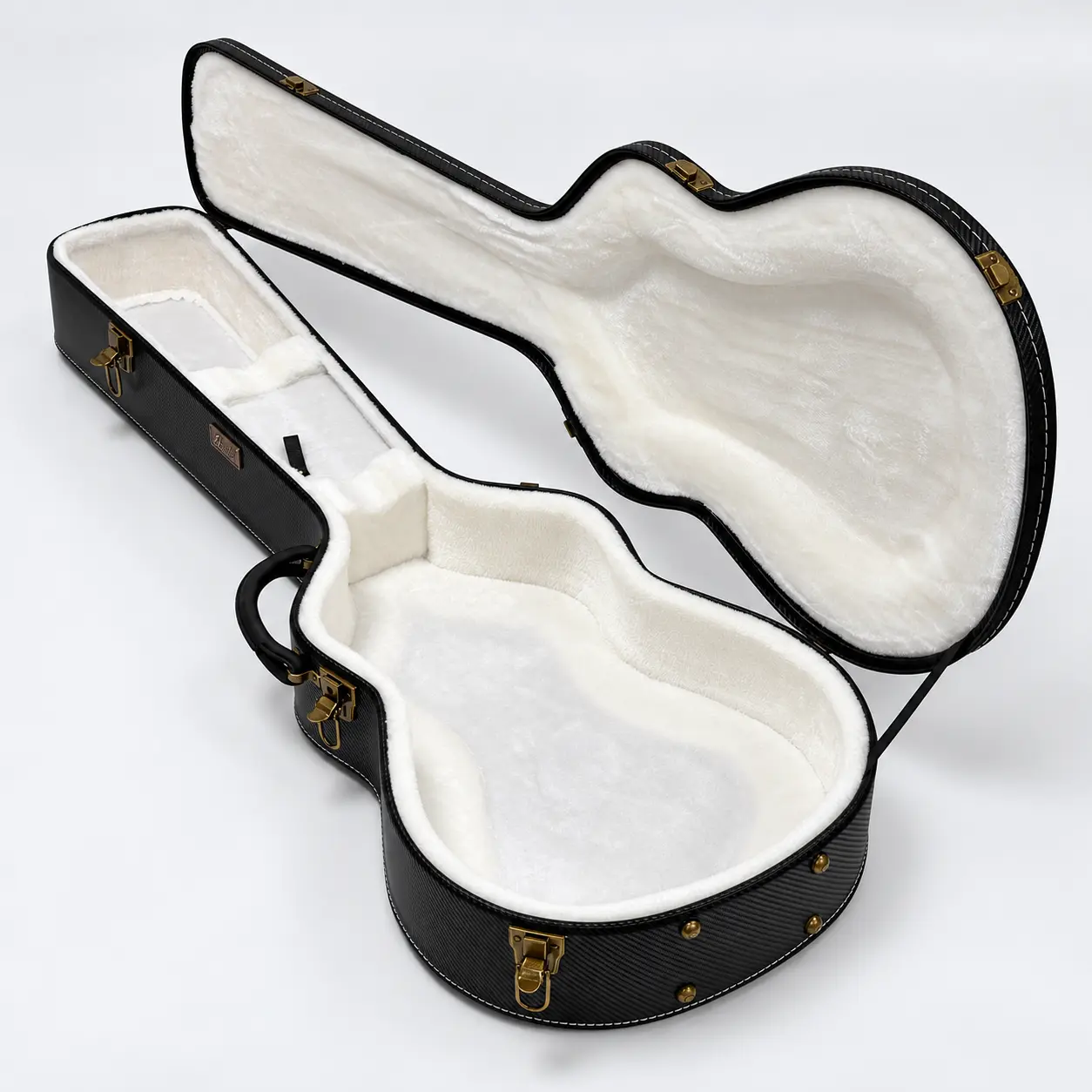
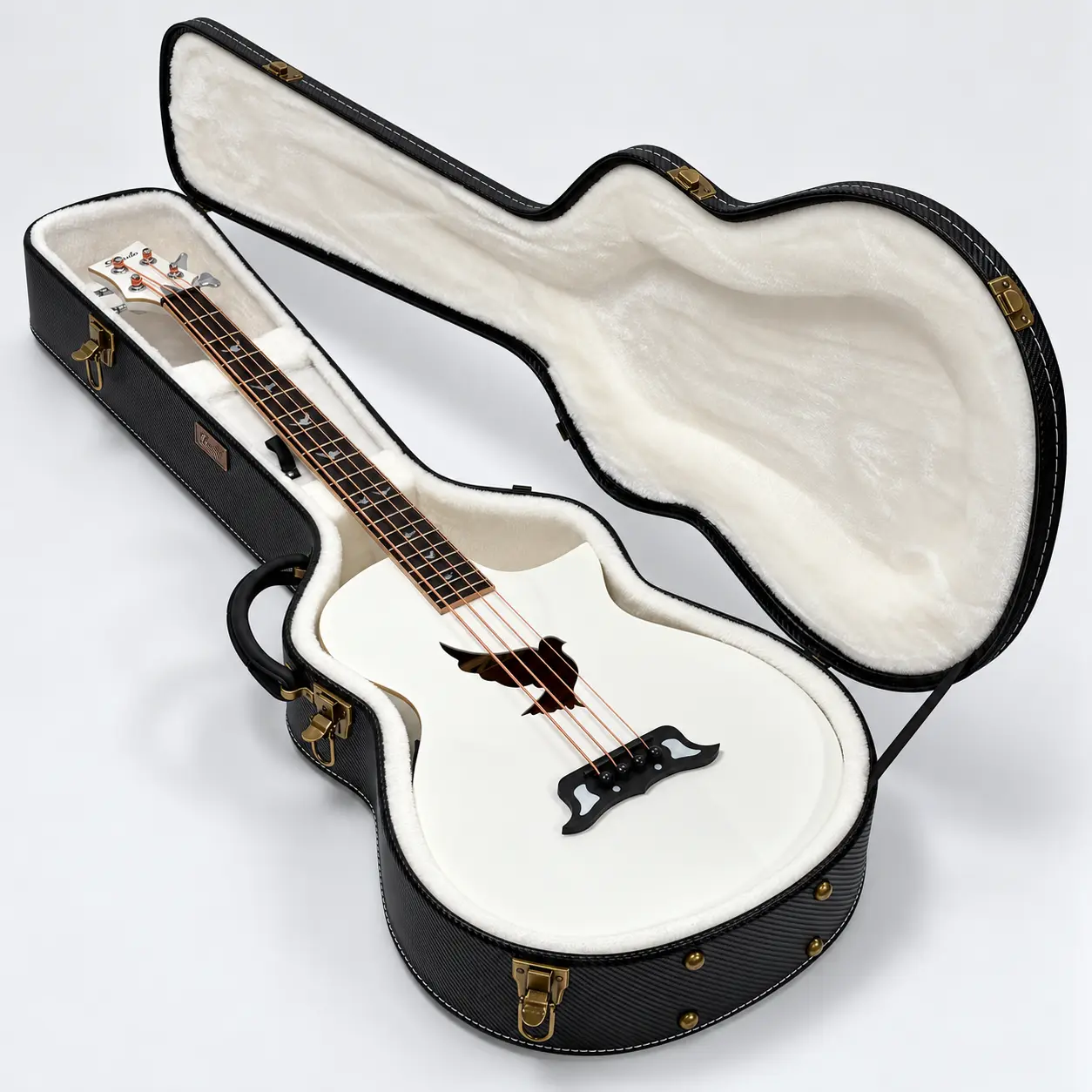
The White Dove is supplied with its own premium hard case. A black textured exterior, stitched edges and brass-coloured fittings give it a restrained finish alongside the white instrument.
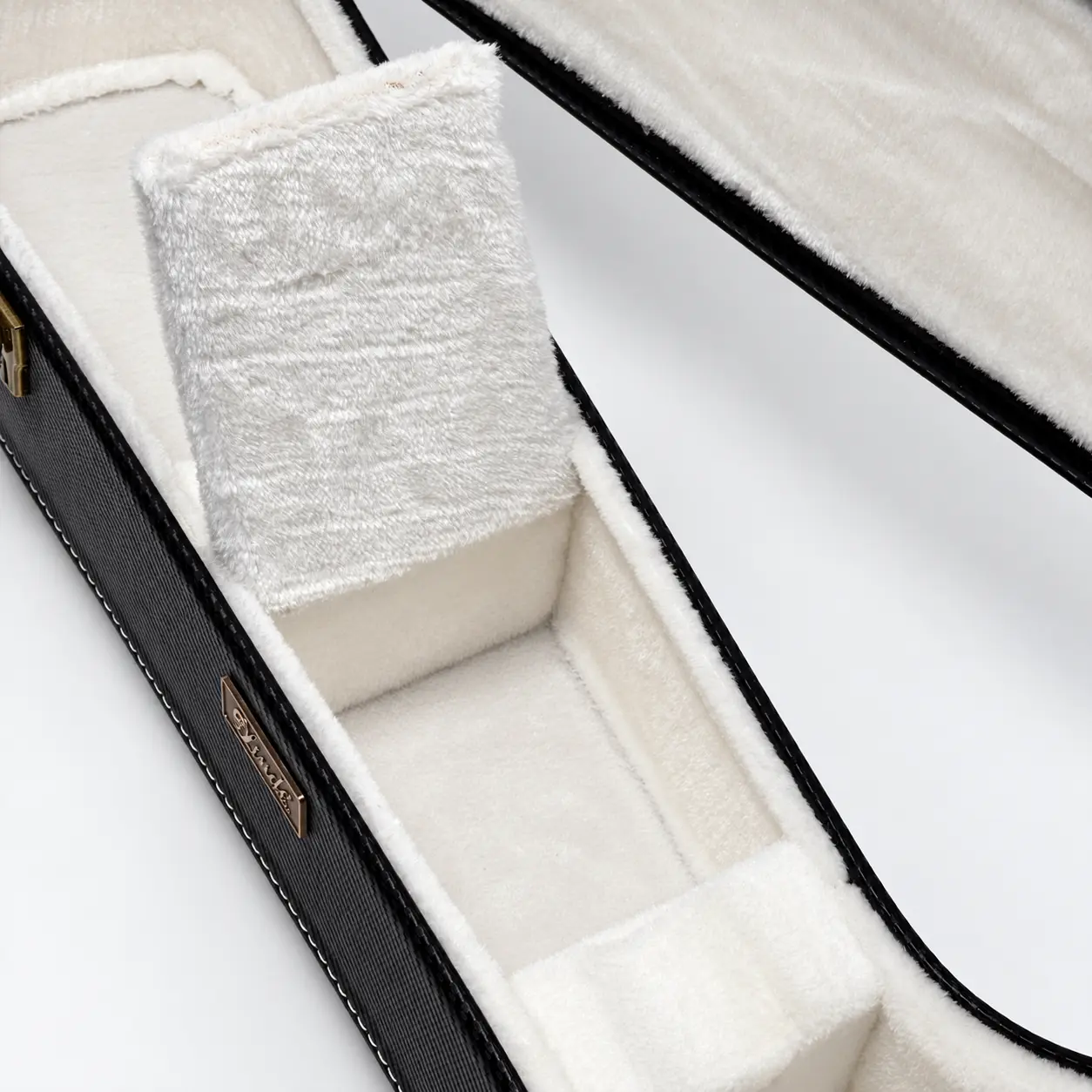
Open the lid and the contrast changes to cream plush lining, shaped around the bass. A covered storage compartment sits within the interior, while the carry handle and Lindo badge complete the outside.
The case is part of the product offered here, rather than an optional extra.
08 · Instrument and case
Made to be seen together
The full pairing brings out the White Dove’s contrasts: gloss white against a cream-lined interior, a dark fretboard carrying the bird inlays, and warm maple following the body’s outline. The view below shows the bass within its included hard case.
09 · Dimensions
The White Dove, in proportion
The 30-inch scale is paired with an overall length of 1110 mm and a maximum body width of 370 mm. The key measurements are set out below as readable text, followed by the manufacturer’s four-string bass drawing.
- Scale length
- 30 inches · 762 mm
- Overall length
- 1110 mm
- Body length
- 490 mm
- Maximum body width
- 370 mm
- Body depth
- 80 mm
- Headstock
- 172 × 84 mm
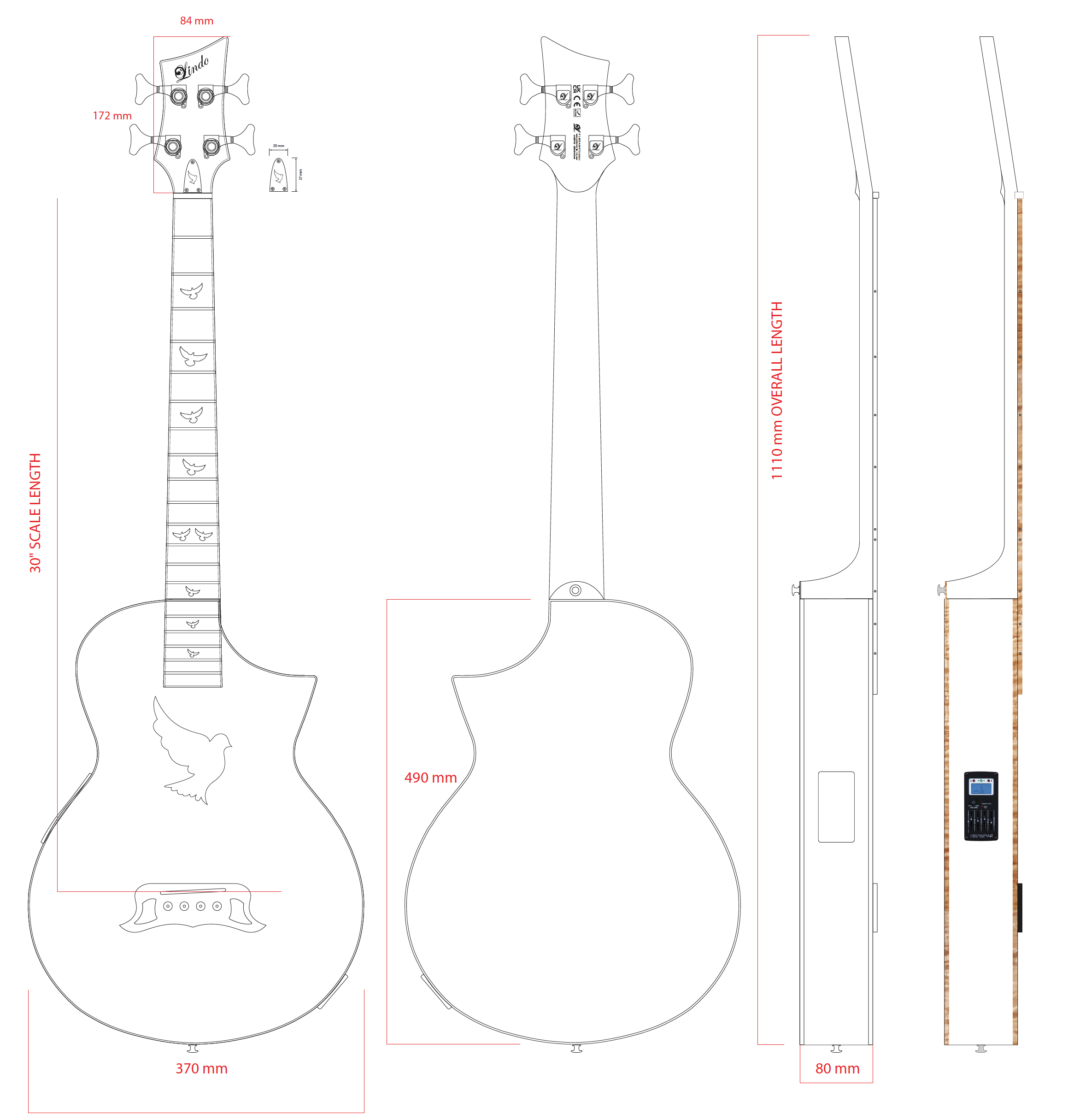
The manufacturer’s dimension drawing is shown above with its original labels.
10 · Specifications
Every detail, clearly set out
| Item | Detail |
|---|---|
| Model | Lindo White Dove Short Scale Electro Acoustic Bass Guitar |
| Orientation | Right-handed |
| Strings | 4 |
| SKU | LINDO_WD_ACOUSTIC_BASS |
| EAN | 5060244179080 |
| Colour and finish | Gloss white |
| Top | Spruce |
| Back and sides | Sapele |
| Body binding | Roasted maple |
| Body style | Single cutaway, with dove-shaped soundhole |
| Neck | Mahogany |
| Neck profile | C-shape |
| Neck joint | Dovetail |
| Neck reinforcement | Two carbon fibre rods |
| Truss rod | Dual-action |
| Fretboard | Black composite wood |
| Bridge | Black composite wood |
| Fretboard radius | 16 inches |
| Frets | 20 |
| Fretwire | 3 mm nickel alloy, with rounded ends |
| Fretboard inlays | Mother-of-pearl dove inlays |
| Fretboard binding | Roasted maple |
| Side position markers | Luminous |
| Scale length | 30 inches (762 mm) |
| Nut | High-density synthetic, 43 mm wide |
| Saddle | Graphite, 75 mm |
| Tuning machines | Chrome, 18:1 ratio |
| Truss rod cover | Aluminium with recessed dove detail |
| Headstock volute | Yes |
| Strings fitted | Bass strings, .045–.105 |
| Bridge pins | 4 black bridge pins with coloured shell centres |
| Electronics | F-4T four-band EQ and digital tuner |
| EQ controls | Bass, middle, treble and presence, plus master volume |
| Outputs | Jack and XLR |
| Strap buttons | Chrome, at the neck heel and body base |
| Internal label | Laser engraved |
| Bracing | Openwork bracing |
| Overall length | 1110 mm |
| Body length | 490 mm |
| Maximum body width | 370 mm |
| Body depth | 80 mm |
| Headstock dimensions | 172 × 84 mm |
| Included case | Premium hard case |
| Price | £899.99 |