




The circle in the landscape
A still pool, a bird at the water’s edge and a cluster of pale blossoms all had their place in Koya’s artwork. Then the drawing had to leave room for the instrument itself.
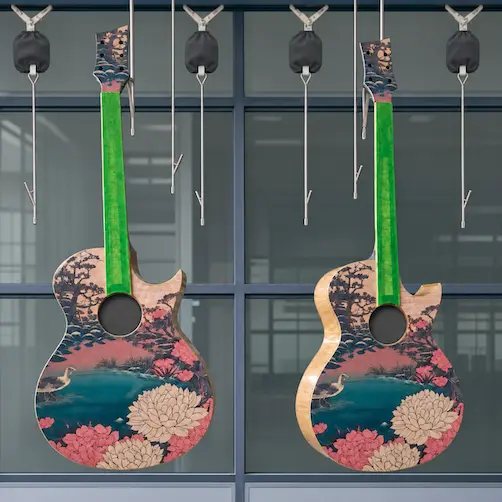
The Koya Acoustic journal · 05 / 8
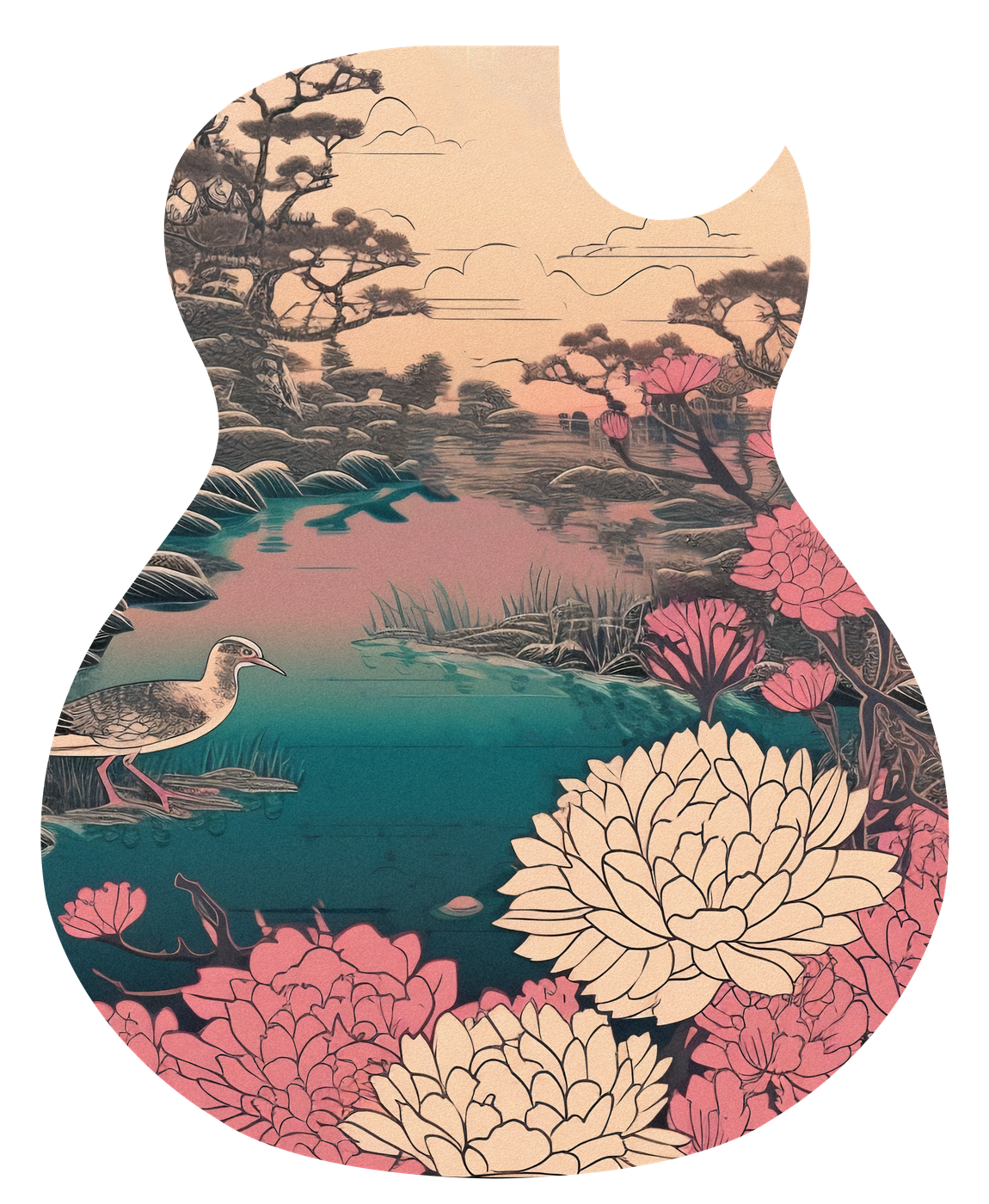
Begin with the artwork before the soundhole appears. A bird stands at the edge of blue-green water. Dark branches lean into the frame and pale blossoms gather along the bottom. Your eye can follow the shore from one side of the picture to the other, almost as if the scene could keep going beyond the edge of the page.
The outline is already unmistakably that of the Koya. The trees and water share a surface that narrows at the waist and opens into the lower bout. A separate scale drawing introduces a round soundhole and a bridge. Seen together, the two designs show how a picture can take its shape from the instrument it will belong to.
Making room for the instrument
In the workshop photographs, the circle sits above the pool. The flowers still have space to spread along the lower edge, and the woodland draws the eye across the upper body. Beside the soundhole, the cutaway gives the upper corner its own shape and changes how much of the picture can fit there.
The spruce carries the graphic across the face. Seen at an angle, the pale figured maple sides come into view. The change of material gives the scene a clear boundary and makes the curve that holds it easier to see.
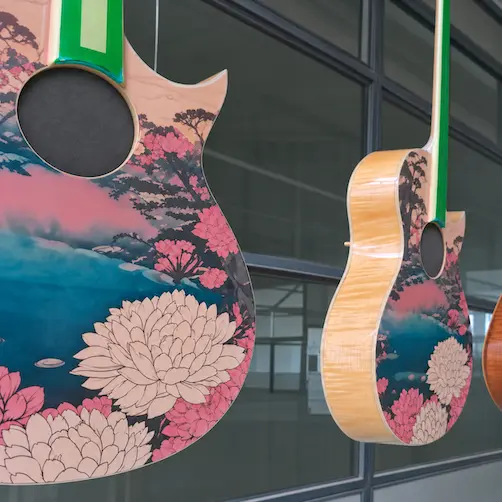
The drawing places the bridge over the water. Once the strings are in place, they lead the eye up through the scene towards the neck, the same direction a player’s attention travels between a strum and the next chord.
Seen whole, all those decisions recede a little. The eye finds the bird again, and for a moment there is just the water and the quiet stretch of shore.