




Earth and Moon
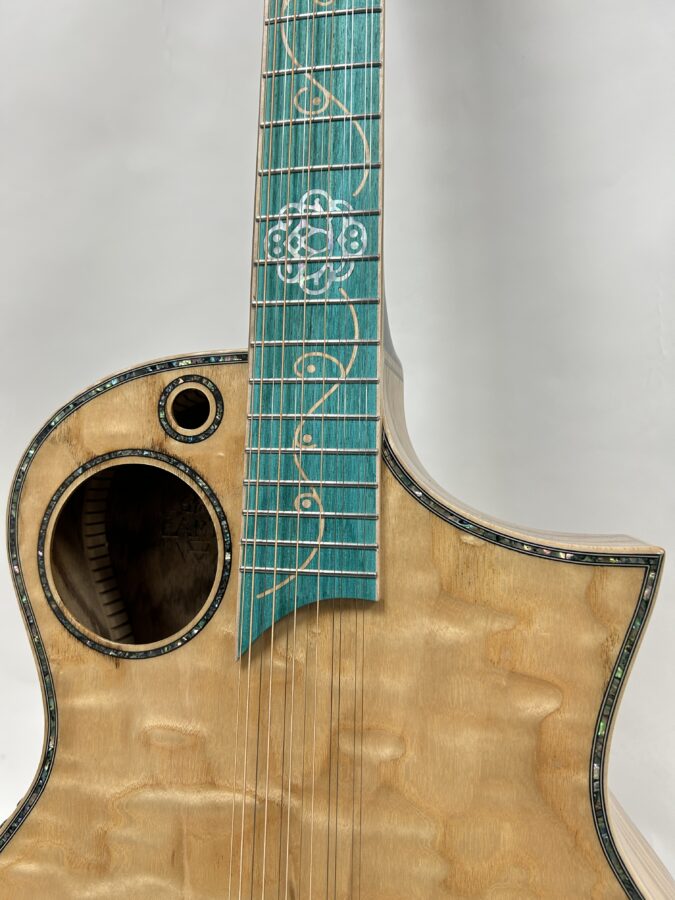
Two circular soundholes give the Earth 12 a recognisable face. Their off-centre position brings a celestial idea into the body of the guitar, with abalone tracing each opening.
The Earth 12 journal · 02 / 6
The larger circle draws your attention first. Then you notice its smaller companion, sitting just above it beside the fingerboard. Together, they give the Earth 12 a face that is easy to remember. The relationship is simple enough to recognise from across a room and detailed enough to reward a closer look.
Earth and Moon are the names behind this pairing. The larger opening measures 80 mm across; the smaller one is 20 mm. That difference gives each a distinct presence, while their position close together lets the idea read as a pair within the broader outline of the guitar.
A familiar relationship in two circles
These circles open directly into the acoustic body. Soundholes allow air to move between the enclosed cavity and the room as the instrument vibrates. Here, both are placed towards the shoulder, leaving a broad area of figured Tamo ash below and beside the strings, where the bridge has its own place.
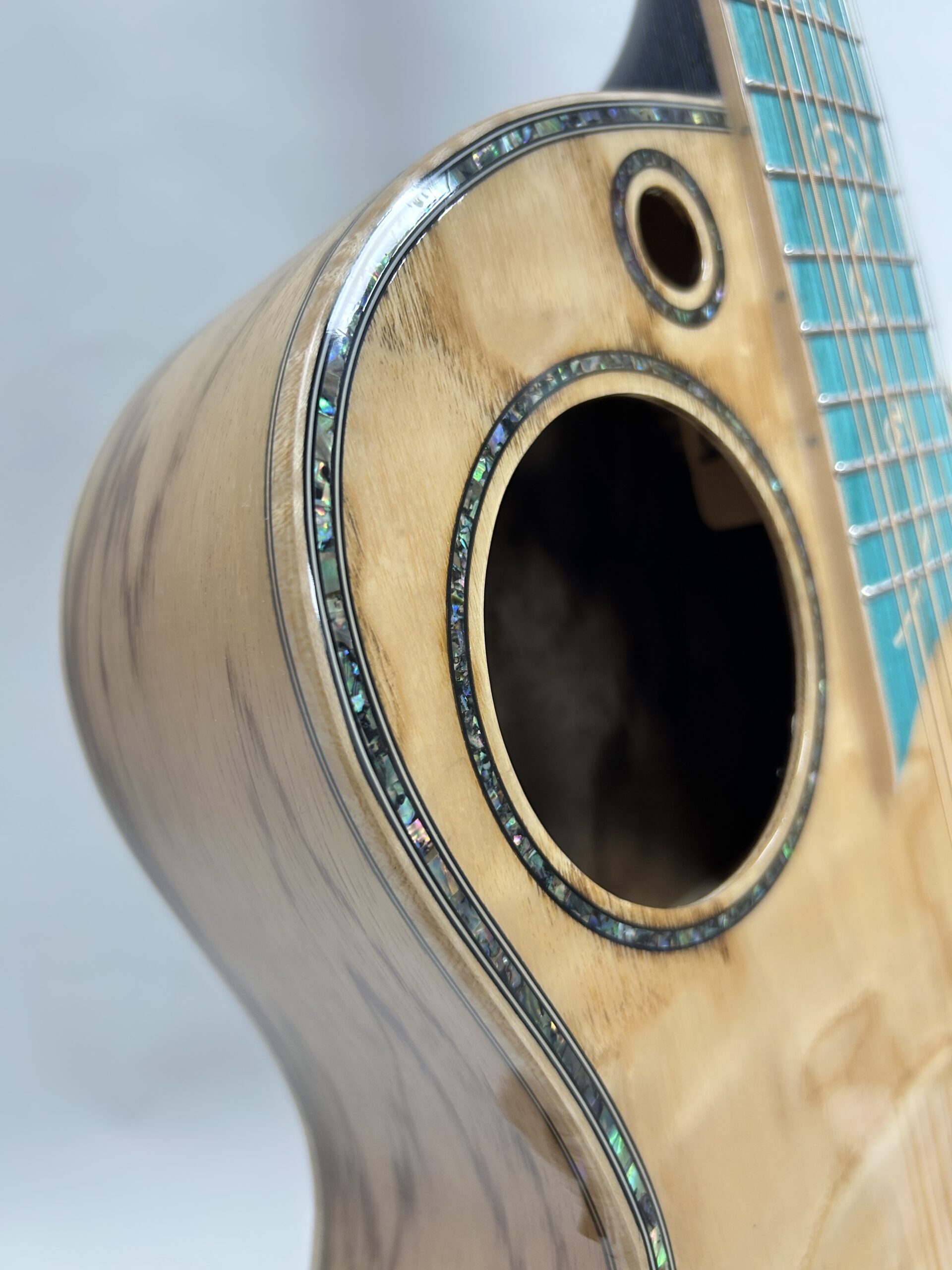
Abalone follows the circumference of each opening. Its small shifts of colour give the dark interior a bright boundary against the timber. Look from a different angle and another fragment catches the light; the outlines remain clear while their reflections change.
The same shell detail continues around the body, connecting the two circles with the guitar’s outer edge. Within each ring, timber, shell and the open centre meet along a continuous curve. Those close-fitting boundaries are where the scale of the work changes, from the sweep of the body to a detail you can examine nearby.
At a distance, the two openings form a recognisable signature. Up close, there are individual colours and edges to explore. The design works at both scales, letting Earth and Moon remain immediately familiar while keeping something smaller to discover when the instrument is in your hands.